Oxy-fuel (Gas Welding)
Flame instead of — , brazing, and cutting with fuel gas and oxygen
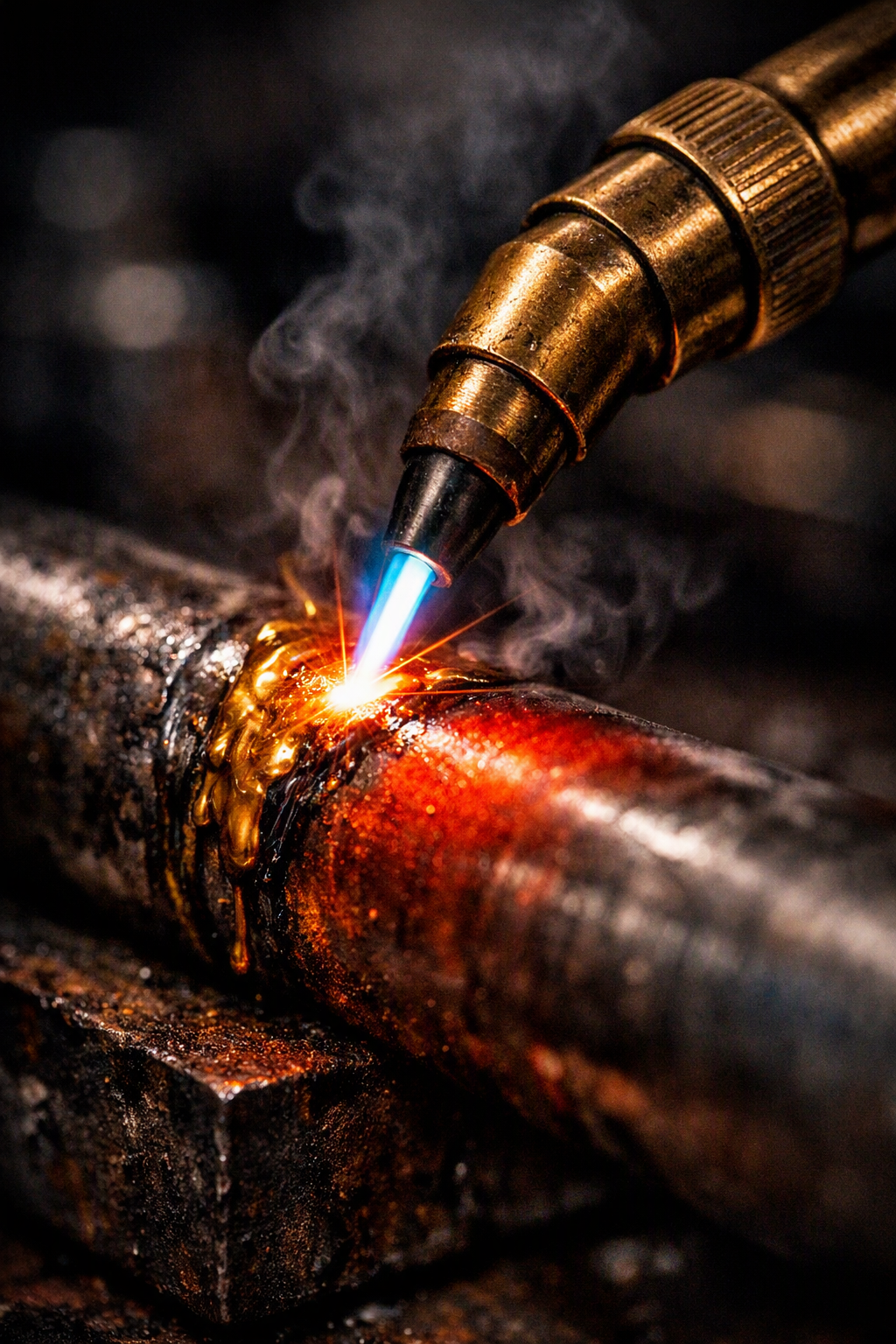 AI generated
In the autogenous process, a fuel gas-oxygen flame generates the heat — no electricity needed. The flame melts the metal, and the filler rod is fed by hand. The grandfather of all welding processes lives on: for brazing, cutting, repairing, and anywhere there's no power.
— commonly called "autogenous" — is the grandfather of all welding processes. Instead of an , a flame generates the heat here: A fuel gas (usually acetylene) burns with oxygen and reaches over 3000 °C. With this flame, you melt the metal and feed the filler rod by hand — no power source needed.
Why acetylene gets so hot
The flame is a little chemical factory. Acetylene burns in two stages: First it decomposes into and hydrogen and burns with the supplied oxygen — this creates the brightly glowing first combustion zone, the inner cone. Behind it, the rest burns with oxygen from the surrounding air. This two-stage combustion is exactly what makes the flame so hot (around 3160 °C) and at the same time so easy to control. Other fuel gases like propane achieve less and heat up more slowly — that's enough for brazing and preheating, but for fusion welding of steel, acetylene is the benchmark.
The big advantage: Autonomy. No electricity, no shielding gas cylinder, no coated electrode — just a torch, fuel gas, oxygen, and a filler rod. The process works anywhere, even far from any power outlet.
The flame is the tool — and you can adjust it
• Neutral flame: Oxygen and fuel gas in the right ratio, with a clearly defined inner cone — for steel.
• Reducing flame (carbon-rich): More fuel gas — for brazing and for materials that can't tolerate oxidation.
• Oxidizing flame (oxygen-rich): More oxygen — hotter, but oxidizing, only for special cases like brass.
The flame tells you its setting: A short, sharply defined inner cone means neutral, a long, ragged cone means too much oxygen, a fuzzy, pale cone means too much fuel gas.
Torch & nozzle
Choose the nozzle size to match the sheet thickness — a nozzle too small doesn't give enough heat, one too large overheats the sheet. Welding is done "leftward" (thin sheets, torch pushed in the welding direction) or "rightward" (thick sheets, torch pulled against the direction). The filler rod for steel is usually low-carbon and copper-coated to prevent rust.
Four tasks where autogenous remains unbeatable:
1. Soldering & brazing: The fine difference to : When brazing, only the melts, not the — it stays solid. The flame provides controlled heat where the would be too coarse: copper pipes, radiators, jewelry, plumbing, body panels.
2. Oxy-fuel cutting: Here an oxygen jet literally burns the heated iron and blows it away. The sheet is first brought to ignition temperature with the flame, then the pure oxygen jet cuts — no other process cuts thick plate so economically.
3. Repair & thin sheets: Bodywork, gutters, sheet metal — wherever gentle, well-controlled heat is needed.
4. Heating, straightening & : The flame is also a precise heat source. You can use it for before , for straightening distorted sheets, or for — tasks for which an would be far too coarse.
The price: lots of heat, lots of distortion
The flame applies its heat over a wide area — the is large, the sheet distorts, and build up throughout the part. That's why autogenous welding on thin sheet belongs in experienced hands: If you heat until it glows, you've already got the wave before the weld is even laid.
Safety is top priority here: Acetylene is highly explosive. Never operate cylinders lying down, use pressure regulators and flashback arrestors when changing, and when galvanized parts, toxic zinc fumes are produced — ventilate well or use extraction.
The disadvantages: It's slow, heat input is high (lots of distortion), and weld quality never reaches that of an arc process. That's why autogenous has largely been replaced for structural applications today — but as a craft technique and for brazing, it remains indispensable.