Stud Welding
Threaded studs in seconds — the quick way to secure attachment points on sheet and beam.
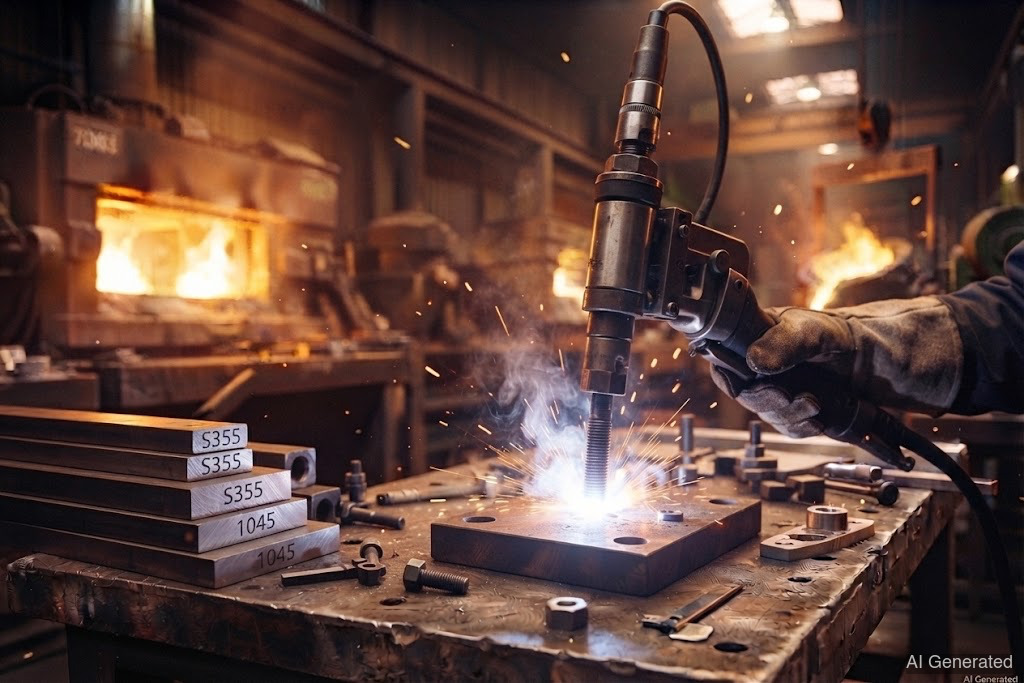 AI generated
In stud welding, a stud is welded directly onto a sheet or beam with a short arc — in a fraction of a second. No drilling, no poking through: the stud becomes a strong, tight connection for threads, fasteners, and headed studs in steel construction.
Stud welding (DIN EN ISO 4063 number 78) solves an everyday problem: how do you permanently attach a threaded stud, a pin, or a headed stud to a sheet or beam without drilling or riveting? The answer: with a short, precise arc in a fraction of a second.
Here's how it works — two ignition methods:
• Tip ignition: The stud has a small tip. When it touches down, a high short-circuit current flows through this tip, which immediately vaporizes and ignites the arc. The stud is then slightly lifted ("lift") and, after melting, pressed into the weld pool.
• Lift ignition with pilot current: A weak pilot arc is struck first, then the gun lifts the stud, the main current flows, and the stud plunges into the molten pool. Cleaner and better controlled — the standard for larger studs.
For larger studs, a ceramic ferrule is used (stud welding with ceramic ferrule): it shapes the weld around the stud, holds the molten pool together, shields it from the atmosphere, and ensures a clean, uniform weld. After welding, it's simply knocked off.
Preparation matters: The surface must be bare and free of scale, rust, oil, and paint — otherwise, the arc becomes unstable and the joint porous.
The advantages:
• Extremely fast: A stud is set in less than a second — ideal for mass production and long beams with many studs.
• No drilling needed: The sheet remains intact, the joint is watertight from the outside and invisible on the back.
• Only one side accessible: Unlike bolting, you only need access to the front.
• Strong and repeatable: uniform and machine-repeatable.
The disadvantages: The stud must be perpendicular to the workpiece, the sheet thickness must match the stud size (too thin burns through), and you need special stud welding equipment. For quality control, a bend test is usually enough: bend the stud — if the joint doesn't break, it holds.
The domain: headed studs in steel and bridge construction (composite beams on girders), vessel construction, shipbuilding, insulation fasteners, cable trays, and anywhere you need threaded points quickly and tightly on sheet.