Laser Welding
Precision with focused light — narrow welds, minimal heat, highest speed
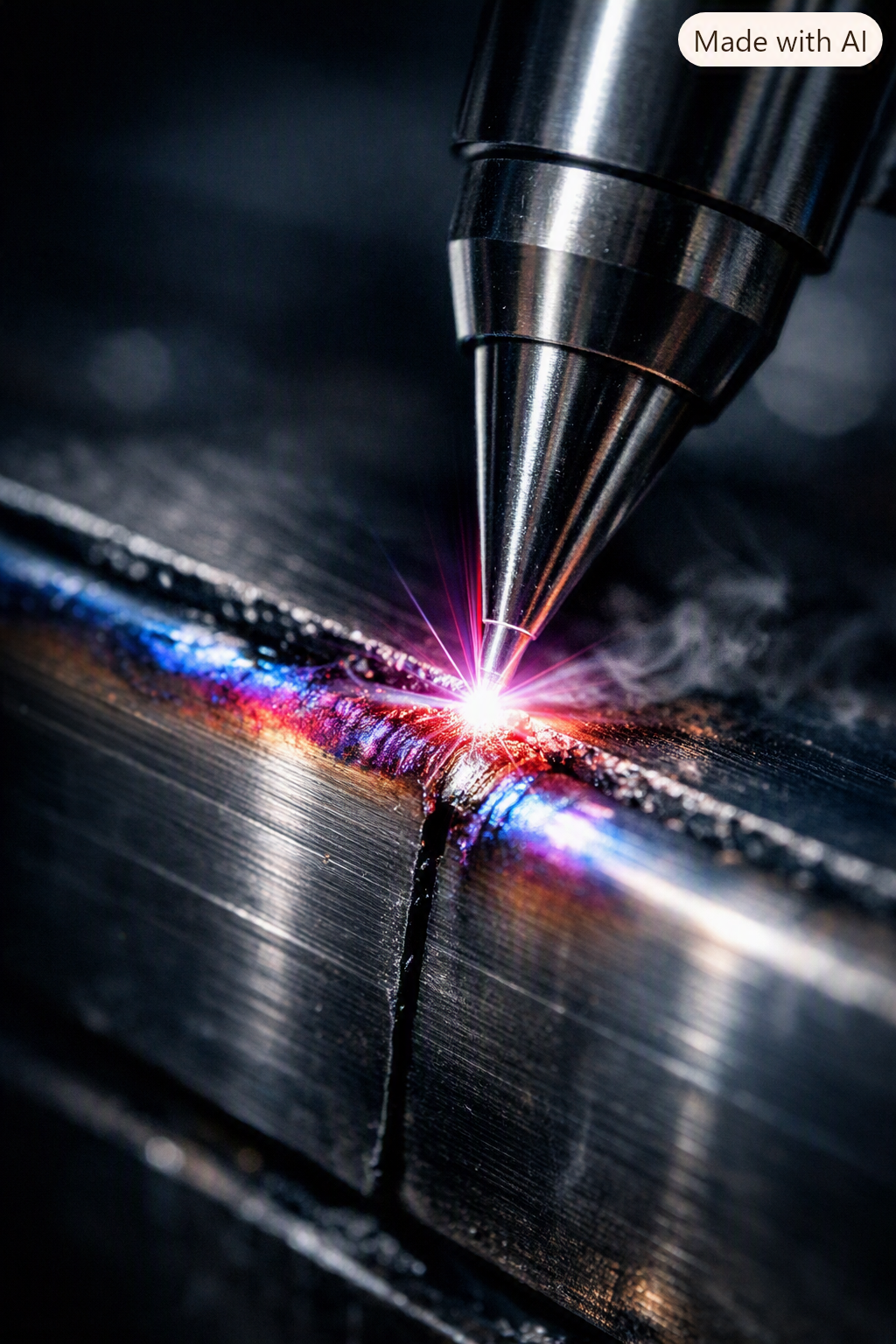 AI generated
In laser , a laser beam focuses its energy on a tiny spot and melts the material without contact. The result is extremely narrow, deep welds with minimal and distortion — the benchmark for precision and speed in series production.
works completely differently from all arc processes: here, no melts the material, but a focused laser beam. The beam concentrates its energy on a spot of fractions of a millimeter — the energy density is so high that the metal vaporizes instantly and a "vapor channel" (keyhole) forms. The laser "drills" through the material, and behind the focus, the melt closes again to form the weld.
The result is the exact opposite of SMAW:
• Extremely narrow, deep welds: The depth-to-width ratio can be 10:1 or more.
• Minimal : The heat is concentrated on the spot, the rest of the part stays cold — hardly any distortion, hardly any microstructural change.
• Highest speed: Thin sheets are welded in fractions of a second.
Plus: Non-contact. The laser needs no electrode, no wire contact, no torch at the workpiece. This allows in hard-to-reach places and perfect automation with robots.
What types of lasers are there?
They are distinguished by the medium that generates the light:
• CO₂ laser (10.6 µm): The classic for thick steel plates. Long the standard, now largely replaced in welding technology.
• Fiber laser (approx. 1.06 µm): The modern standard. Compact, highest efficiency, light can be routed via fiber optics. Ideal for robots and fine welds.
• Disk laser (approx. 1.03 µm): Very high power with excellent beam quality — for thick plates and high speeds.
• Diode laser: Directly from semiconductors, softer beam — more for brazing and cladding.
In the past, there was also the Nd:YAG solid-state laser (1.06 µm) as a bridge solution; today, fiber and disk lasers dominate.
Why watts and not amps?
Because they are two different physical quantities. In the , power is current times voltage — and since arc voltage is roughly constant (20–40 V), the current in amps directly controls the heat. In laser, the beam delivers light (photons), not electric current — the relevant, directly measurable quantity is optical power = energy per second = watts. There simply is no "current" in the beam. The system does draw electrical power from the outlet (also in watts), but converts it to laser light with 30–50% efficiency. That's why lasers are classified by their optical output power in watts — typically 0.5–20 kW, depending on sheet thickness.
What gas is used?
The process/ has two jobs in laser welding: it protects the pool from oxidation and controls the plasma plume above the weld, which can weaken the beam:
• Helium: Best for suppressing plasma — for deep welds, especially with CO₂ lasers.
• Argon: Standard for fiber and disk lasers on steel and stainless steel.
• Nitrogen: For stainless steel (stabilizes the microstructure), but with risk of porosity.
• Galvanized sheets: Special gas mixtures, because the vaporizing zinc can tear the weld.
The two basic processes:
• Conduction welding: At low power, the beam only melts the surface — wide, flat, smooth welds, similar to brazing.
• Deep penetration welding (keyhole): At high power, the beam pierces through the material — deep, narrow welds for structural joints.
Applications are the domain of precision and series production: automotive (body parts, transmissions), battery cells, electronics housings, medical devices, and everything where distortion would be a problem.
The price: The systems are expensive, joint preparation must be exact (gap near zero), and safety requires laser class 4 with closed cabins. For workshop one-off production, laser is rarely the first choice — there, GMAW/MAG or TIG rules.