Brazing and Soldering
Joining below the melting point — gentle, tight, and ideal for dissimilar joints
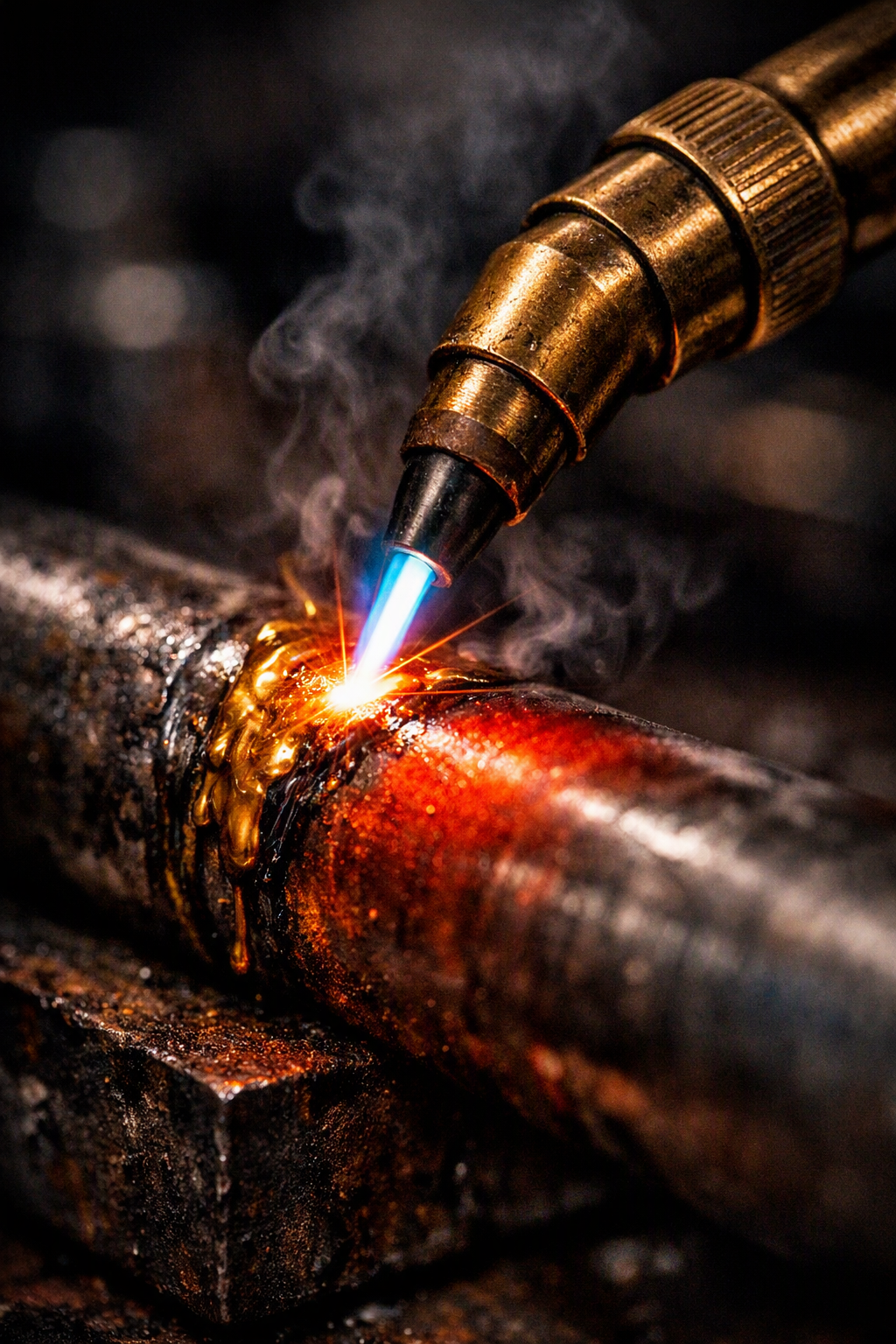 AI generated
In brazing and soldering, it's not the that is melted, but only the filler metal. The joint forms through capillary action in the narrow gap. This makes brazing/soldering gentle, low-distortion, and ideal for thin parts, copper pipes, electronics, and dissimilar joints.
Brazing and soldering are joining processes with one crucial difference from : The is not melted. Only the filler metal — a with a lower melting point — becomes liquid and joins the parts. The joint forms through : The liquid filler metal is drawn into the narrow gap between the faying surfaces and solidifies there.
Capillary action: Why the gap must be narrow
Imagine a narrow gap between two clean sheets of metal. Liquid filler metal wets the surfaces and is drawn into the gap by itself — like water in a narrow tube. That's exactly what capillary action is. It only works if the gap is narrow and uniform (typically 0.05–0.2 mm for brazing): Too wide, and the suction effect breaks off; too narrow, and the filler metal won't flow in at all.
Flux: The invisible helper
Every metal surface carries an — that prevents the filler metal from wetting. The dissolves this , lowers the surface tension of the filler metal, and keeps the surface clean during heating. Without flux, the filler metal just sits as a droplet instead of creeping into the gap.
A distinction is made according to working temperature:
• Soldering (below 450 °C): With low-melting-point filler metals (often tin-based). For electronics, copper pipes, sheet metal, and joints that can't withstand high temperatures.
• (above 450 °C): With brazing filler metals based on copper, silver, or brass. Stronger than solder — for copper lines, tools, radiators, and mechanically stressed joints.
• (above 900 °C): For highly stressed joints, often under or in vacuum.
Why braze/solder instead of weld?
• No melting of the : The material keeps its properties — no fusion zone, hardly any microstructural change.
• Little distortion: The heat input is lower and more uniform — ideal for thin and sensitive parts.
• Dissimilar joints: Copper with brass, steel with — materials that are hard to weld can be brazed/soldered.
• Tight, smooth joints: Capillary action fills the gap completely — tight and clean.
The applications are huge: plumbing and heating pipes, electronics and circuit boards, cutting inserts, heat exchangers, radiators, jewelry, and fine mechanics. of galvanized body panels also belongs to this family.