GMAW/MIG Welding
Metal Active Gas and Metal Inert Gas — the workhorse of welding technology
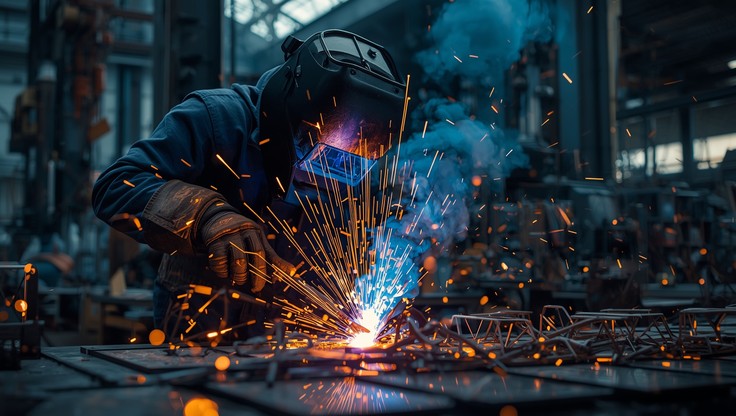 AI generated
In GMAW/MAG/MIG , a continuous wire electrode melts off under and deposits itself into the weld. It's the fastest, most economical process for steel (MAG) and aluminum (MIG) — the standard in the shop and in production.
GMAW/MAG and MIG are siblings: Both use a continuous that comes off the spool, melts off in the , and deposits itself into the weld. The difference lies in the :
• MAG (): The gas is active — or an argon-CO₂ mix. It reacts with the weld pool. MAG is the standard process for mild and low-alloy steels.
• MIG (): The gas is inert — argon or helium, doesn't react. MIG is used for aluminum, copper, and high-alloy steels.
The big advantage over TIG: speed and economy. Your hand stays free, and long welds go in one pass. That's why GMAW/MAG/MIG is the workhorse in every shop, in structural steel, and in production.
Wire feed: 2 rolls or 4 rolls?
The wire is pushed by a motor via rolls from the spool through the hose package to the torch. Here's the first choice:
• 2-roll drive: One driven roll and one pressure roll. Compact and cheap — enough for solid steel wire. But the wire is only gripped at one point; if there's resistance in the hose package, it slips.
• 4-roll drive: Two driven rolls grip the wire at two opposite points. Significantly more feed force and better guidance. A must for soft wires (aluminum, ) and for long or tightly bent hose packages where friction is high.
The core: Which liner for which wire?
Inside the hose package, the wire runs through a guide — the liner. Which one you need depends on the wire:
• Steel liner (spiral liner): Robust steel coil for solid steel wire. The wire runs clean, and the liner lasts long.
• Teflon or plastic liner: For aluminum and stainless steel wire. Aluminum is soft — in a steel liner it wears off shavings that clog the liner and cause porosity in the weld. The plastic liner protects the wire.
• CFK/nylon liner: Light and low-friction, for long, tightly bent hose packages and thin wires.
Remember: Steel wire in a steel liner, soft wire (aluminum, ) in a plastic or Teflon liner — otherwise you'll fight feed problems and porosity.
Wire size and required power
The wire size you choose determines the required power — i.e., welding current and deposition rate. Rough guidelines for solid steel wire (argon/CO₂):
• 0.6 mm: approx. 40–120 A — sheet metal, bodywork, thin profiles.
• 0.8 mm: approx. 60–180 A — sheet 1–3 mm, the standard in the trade.
• 1.0 mm: approx. 80–240 A — 3–6 mm, the all-rounder.
• 1.2 mm: approx. 120–320 A — 6–15 mm, structural steel and thick sections.
• 1.6 mm: approx. 200–450 A — thick plates, high deposition rate, often as .
The actual control variable is the : More wire per minute means more current and more power. Thicker wire achieves more deposition at the same current, but also needs more power to melt at all — so each wire diameter has a matching current range.
The transfer mode — how the wire drops into the pool
• : At high power, the wire detaches as a fine stream of droplets. Deep penetration, high deposition rate — for thick plates and horizontal welds.
• Short circuit arc: At low power, the wire dips into the pool, melts off, and re-ignites. Low spatter, good for thin sheets and out-of-position welds.
• : The current pulses in a controlled manner — one droplet per pulse. Spatter-free like TIG, but faster. Ideal for aluminum, stainless, and out-of-position.
Besides solid wire, there's wire with powder filling — it forms slag, improves bead surface, and suits thicker sections and outdoor work.
The limits: GMAW/MAG/MIG is sensitive to drafts (the gas shield collapses, porosity forms) and forgives less than SMAW when it comes to rust, , and dirt. For structural welds, the certified welding procedure applies anyway.