Friction & Friction Stir Welding
in the solid state — friction instead of melt for aluminum, batteries, and dissimilar joints
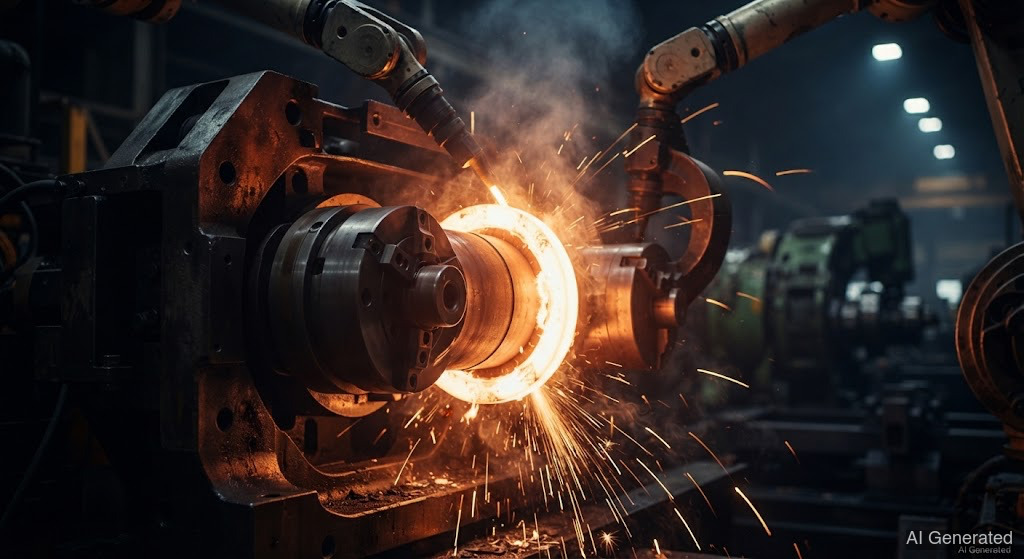 AI generated
In friction and friction stir welding, the joint is made without melting: friction heat makes the material doughy, and pressure welds it in the solid state. The result is pore- and crack-free welds — even with materials that are hard to weld conventionally.
and (DIN EN ISO 4063 numbers 42 and 43) break with a basic assumption of : Nothing is melted here. The joint is made in the solid state — the material is only softened to a doughy consistency and welded together under pressure.
How friction becomes heat
Friction generates heat — everyone knows that from rubbing their hands together. In , this is used industrially: Two surfaces rub against each other so vigorously that the surface becomes doughy. A fine burn-off removes impurities and , then the movement stops and pressure presses the softened surfaces together. The result is a pore-free, high-strength joint — without any melt.
Two variants:
: One workpiece rotates and is pressed against the second with great force. The friction at the contact surface generates so much heat that the material becomes doughy; then rotation stops, and the pressure welds both parts together. Ideal for rotationally symmetric parts — shafts, axles, valves, turbocharger rotors.
(FSW): A rotating tool with a pin is guided along the joint. The pin plunges into the material, softens it by friction, and "stirs" it together behind it. This creates a continuous weld in sheets and profiles.
The advantages are unique:
• No melt, no solidification defects: No pores, no hot cracks, no spatter — the classic problems of fusion welding are eliminated.
• Fine structure: The mechanical kneading produces a fine-grained, strong structure.
• Hard-to-weld materials: Aluminum alloys that are difficult to weld crack-free with the can be joined excellently with FSW — even dissimilar joints of different alloys.
• Low heat, little distortion: The temperature stays below the melting point, and heat input is low.
The limitations: The workpieces must be firmly clamped (high clamping forces), geometries are limited (no fillet welds, no thick-walled joints), and the equipment is tailored to the part shape.
The domain: Aluminum profiles in rail and vehicle construction, battery housings, heat exchangers, axles, and wherever lightweight construction and pore-free welds are required.