Resistance Spot Welding (RSW)
without an —thousands of spots in minutes, the benchmark in automotive manufacturing
 AI generated
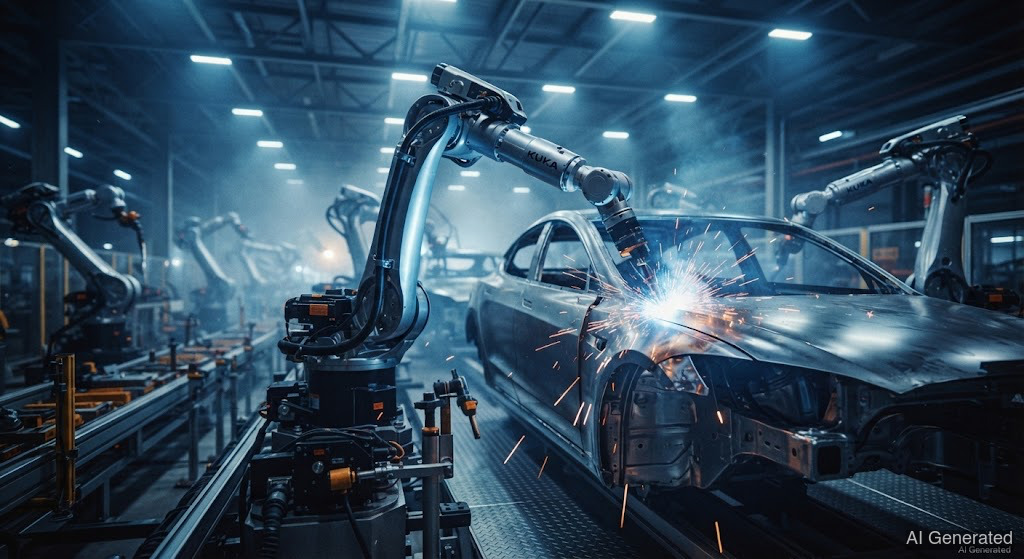
In resistance spot welding, there is no ; instead, a strong current flows directly through two pressed-together sheets. The resistance heat melts a small lens-shaped nugget. The process is lightning-fast, needs no filler, and is the standard for every car body.
(RSW, DIN EN ISO 4063 process number 21) is a completely different principle from all arc welding processes: here there is no . Two copper electrodes press the sheets together, and a very high current flows through the material for fractions of a second. At the contact surface of the sheets, the electrical resistance is highest—that's exactly where the heat is generated that melts a small lens-shaped nugget (the weld point).
The physics: current, time, and pressure
The heat follows a simple formula: Heat = current² × resistance × time. If you triple the current, you get nine times as much heat—that's why the process is extremely sensitive to current. You control four variables:
• Welding current: Determines how hot the spot gets—the thicker the sheets, the more current.
• Weld time: Usually fractions of a second. The process is extremely fast, but the time must be exactly right: too short = cold spot, too long = spatter and electrode wear.
• Electrode force: The electrodes press the sheets together until the nugget solidifies. Too little pressure = spatter, too much = flat spot with insufficient penetration.
• Cooling: The copper electrodes are water-cooled inside—otherwise they would soften and stick to the sheet after thousands of spots in a row.
The lens-shaped nugget: why the spot holds
The molten nugget is lens-shaped and is rapidly quenched by the cold sheets around it. In the end, you have a small, solid weld nugget—the surrounding area stays cold, so distortion is minimal and the is tiny.
Advantages:
• Extremely fast: One spot in milliseconds—thousands of spots per car body in minutes.
• No filler, no : Just current and pressure—cheap and clean.
• Perfectly automatable: Welding robots place the spots precisely and repeatably.
• Low distortion: The heat stays local to the spot.
Limitations: You need overlapping sheets (no butt joint), sheet thickness is limited, and the individual spot is not gas-tight. Two variants extend the principle:
• Seam welding: Instead of fixed electrodes, copper wheels roll over the sheet and produce a continuous, gas-tight weld—for tanks and containers.
• Projection welding: A small projection is pre-formed on one side. The entire current flows through this tiny spot—multiple spots at once or very precise single spots become possible.
The main domain is clearly automotive manufacturing: every steel car body consists of thousands of spot welds. Also tinplate (sheet metal packaging), household appliances, and general sheet metal work.