TIG Welding
Inert Gas — the precision discipline for stainless steel, aluminum, and titanium
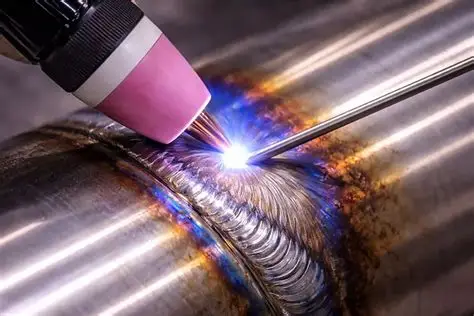 AI generated
In TIG , the burns between a non-consumable tungsten electrode and the workpiece, shielded by an inert gas. The result is clean, high-quality welds without spatter — the benchmark for precision. The price: it's slow and demands skill.
TIG stands for Inert Gas — and it's the process all others are measured against. In , the burns between a non-consumable and the workpiece. An inert gas — usually — shields the and the electrode from the atmosphere.
The key point: The electrode doesn't melt off. You control the and heat input completely independently of the filler you feed by hand as a into the pool. That gives you control no other process offers — that's why TIG is the top discipline for root passes, thin sheet, and high-quality welds.
Polarity & Connections: Where does what go?
With TIG, there's a fixed rule: The ground clamp goes to the positive terminal, the torch to the negative (DC, electrode negative = DC−). Many modern inverters have symmetrical sockets — they look the same because they were originally designed for . If the TIG symbol on the machine is worn off, check the gas connection: it's always right next to the negative terminal.
Also: Put the ground clamp as close as possible to the joint! Every welding current creates an electromagnetic field. If you hang the ground far away, you force the current to take a huge detour — the result is arc blow: The wanders, breaks, and spits to the side.
Electrode Diameter and Current
The rule of thumb: Electrode diameter in mm times 100 gives the approximate maximum current. A 1.6 mm electrode handles up to about 160 A, a 2.4 mm electrode about 240 A. If you go too thin, the electrode melts into a ball and leaves tungsten inclusions in the weld. At higher currents, a small standard torch isn't enough — you need a bigger torch or a water-cooled hose package, or the torch will burn up in your hand.
The Tungsten Electrode: Color Tells the Doping
The electrode is doped with oxides that improve ignition and increase current capacity. The color at the electrode end tells the type (per ISO 6848):
• Red (2% thorium) and Orange (4% thorium): Excellent lifespan, very stable , high current capacity — formerly the standard for DC. But: thorium is radioactive and toxic. Grinding dust must not be inhaled. Due to radiation and disposal issues, they're on the way out.
• Gray (2% cerium): The modern all-rounder — not radioactive, good ignition even at low currents, for AC and DC. The classic thorium replacement.
• Blue (2% lanthanum) and Gold (1.5% lanthanum): Not radioactive, very good ignition and high capacity — also a common thorium replacement.
• White (zirconium): For AC on aluminum — very stable, ball-shaped electrode tip.
• Green (pure ): The classic for AC on aluminum, but lower current capacity.
Remember: In most shops, gray (cerium) and blue (lanthanum) have long replaced the red and orange thorium electrodes — same performance, but without radioactivity. If you're still grinding thorium, you absolutely need extraction or a respirator.
Electrode Stick-Out: Your Gas Shield
How far the electrode sticks out of the gas nozzle determines gas coverage. As a rule of thumb: The stick-out roughly equals the inner diameter of the gas nozzle — for standard applications, 5–8 mm. If it sticks out too far, it protrudes into the air stream, the gas shield breaks down, and the electrode immediately picks up oxygen — porous, oxidized, useless welds are the result.
The Backup Bar Trap
Copper and aluminum conduct electricity excellently — but they conduct heat just as well. A backup bar made of these materials pulls the welding heat and the out of the part in a flash: penetration problems, distortion, and cracking. Better is a nickel plate or woven nickel mat — it conducts electricity but is a poor heat conductor, so the process heat stays in the part.
Polarity Determines the Material
• DC, electrode negative (DC−): For steel and stainless steel. Most of the heat goes into the workpiece, penetration is deep and narrow.
• AC: For aluminum and magnesium. The positive half-cycle breaks up the tough ("cathodic cleaning"), the negative gives penetration.
Applications are everywhere it needs to be clean and tight: stainless steel piping, aluminum structures, titanium in aerospace, thin sheet, and everywhere the of high-quality joints.
Modern Machines: Frequency, Waveforms, and Pulse
Polarity is only half the story. Modern inverter machines give you a whole handful of adjustment knobs that turn the same into a completely different tool. Those who know them get twice as much out of their machine — those who ignore them drive a Formula 1 car in second gear.
AC Frequency: Focusing the
With , the current switches between plus and minus multiple times per second. The classic 50 Hz is standard. Modern machines let you raise the frequency — to 100, 200, often several hundred hertz. What happens? The becomes narrower and stiffer, it focuses. Penetration gets deeper and narrower, and the stays cleanly on track in tight grooves instead of dancing. When aluminum, that means: less wide weld pool, less heat next to the weld, less heat tint — with full cathodic cleaning of the .
Waveform: Square, Sine, or Triangle?
On some machines, you also determine how the current flows in each half-cycle — the waveform.
• Square (+/−): The current jumps immediately to its maximum, stays there, and only flips to the opposite side at the switch. Aggressive, hard penetration, maximum force to break up the . For thicker aluminum.
• Sine (classic): The current rises slowly and falls slowly — in both the positive and negative half-cycles. Gentle, stable , ideal for thin material and sensitive parts.
• Triangle (+/−): Fast rise, fast fall — in both half-cycles. The middle ground between square and sine.
Better machines even let you combine these waveforms — so you can fine-tune AC welding to the specific application.
DC: Linear or Pulsed?
In , you have two basic modes. The linear burns with constant current. The , on the other hand, oscillates between two values: a high pulse current that melts the material, and a low background current that lets the pool cool but keeps the alive.
The frequency — how many pulses per second — is adjustable on many machines from 1 Hz to over 2,500 Hz. At 1–2 Hz, the machine works like a sewing machine: one droplet, pause, one droplet. You can literally see the weld bead build up scale by scale. Crank it up to 2,500–3,000 Hz, and all you get is an ultra-shrill squeal and a consistently stable — clean, smooth welds with low heat input.
TTP: Single Shot
Some machines also offer TTP (single pulse). You set how long the should burn — then it shuts off by itself. A short, precise shot, hardly any heat in the part. Ideal for tacking, thin sheet, and anywhere you don't even give the a chance to grow. On some machines, you can combine single pulse with scratch start — you scratch the electrode exactly where the spot should go. Maximum precision.
Up-Slope and Down-Slope: Welding Without a Foot Pedal
Not everyone has a foot pedal at the start. With the hand switch on the torch, you can set the up-slope and down-slope times. Press the switch, and the current ramps up slowly or quickly to the set maximum — the starts gently, protecting the thin electrode tip. Release it, and the current ramps down in a controlled manner until it actually shuts off. The doesn't extinguish abruptly but fills the crater at the end — no crack initiation at the weld end.