Lead & Tin – Solders and Soft Metals
Soft soldering, brazing, and the responsible handling of heavy metals
 AI generated
Lead and tin are soft, low-melting metals used mainly as solders and for special applications like radiation shielding. When joining, soft soldering and brazing are the focus. Lead is hazardous to health and requires special caution.
Lead and tin are the soft metals among the non-ferrous metals – low melting points, soft, and easy to form. You know tin from soldering and tinplate, lead from radiation shielding, batteries, and cable sheathing. Both are hardly ever welded – their domain is soldering.
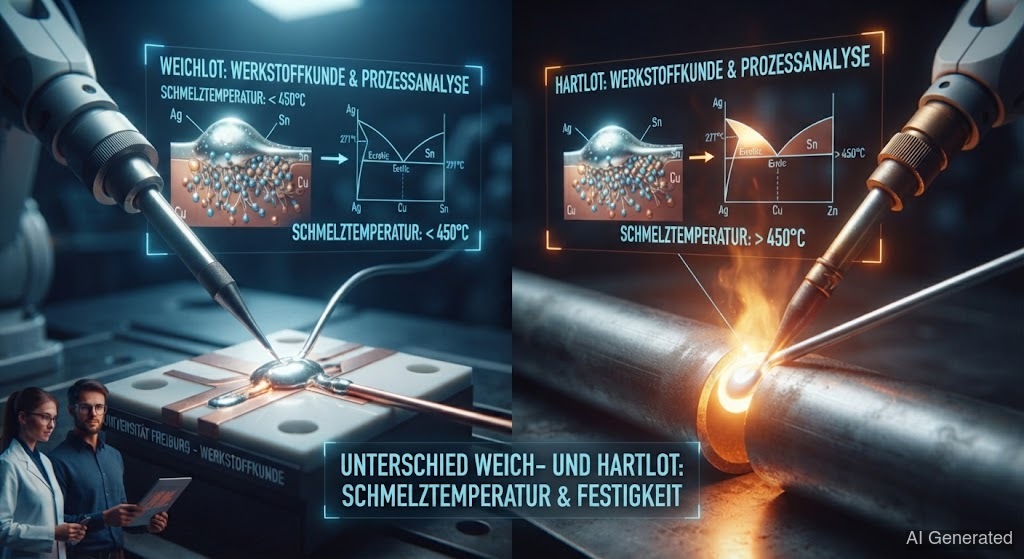
The difference you need to know: works below 450 °C, above it. Soft solders are traditionally tin-lead mixtures, today increasingly lead-free (tin-silver, tin-copper), because lead is hazardous to health. The solder melts, flows into the gap, and joins the parts – the joint holds less mechanically than a weld bead, but it is gentler on sensitive components. That's why you solder electronics, radiators, copper pipes, and zinc sheet instead of welding them.
Two things matter in soldering: the right working temperature and the right flux. The flux removes the so the solder can wet the surface – without flux, the solder runs off in balls instead of creeping into the gap. In with silver solders, temperatures reach 600–800 °C, which is already close to , but the base material does not melt.
The most important point with lead, however, is health protection. Lead is toxic – it accumulates in the body and damages nerves and blood formation. Lead fumes form at temperatures far below the melting point, and lead dust collects on tools and hands. When working with lead: use extraction, wear gloves, wash your hands, and don't eat or smoke at the workplace. Modern lead-free solders make your life much easier in this regard.
Why the eutectic solder was the electronics standard
The classic solder Sn63Pb37 melts at exactly 183 °C — not over a temperature range, but at a single point. This is called eutectic, and that's exactly the advantage: the solder goes abruptly from solid to liquid and solidifies just as abruptly, without a mushy intermediate phase in which components can shift. That's why it was the standard in electronics for decades. Since the RoHS directive, lead has been largely banned there – the lead-free alternatives (tin-silver-copper, SnAgCu) require a slightly higher temperature and more care, but they do without the nerve and blood poison.