Stainless Steels (Rust-Free)
Austenitic, ferritic, and duplex steels: structure & filler metals
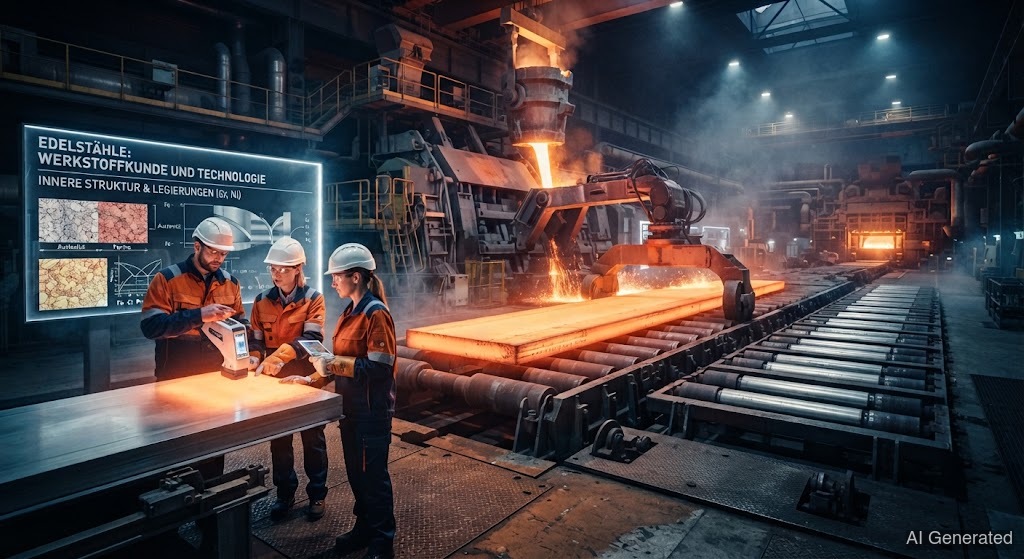 AI generated
Stainless steels are steels with at least 10.5% , which protect themselves against through a self-healing . The three big families – austenitic, ferritic, and duplex – differ in structure, strength, and weldability. What matters most when : heat input, , and the right post-treatment.
“Stainless” means: the steel contains at least 10.5% . The reacts with oxygen and forms a wafer-thin, dense of chromium oxide that shields the steel underneath from air and water. If you scratch it, it repairs itself – as long as enough is available. This very layer is what you must not destroy when .
There are three big families, and each behaves differently when .
Austenitic steels (, , ) are the classics. acts as an and keeps the structure face-centered cubic even at room temperature – making them non-magnetic, tough all the way through, and generally very weldable. But they have two known weak points. First, : When , temperatures around 600–800 °C in the cause to precipitate out of . Right next to them, the grain becomes depleted of – this makes exactly these zones susceptible to , even though the rest of the part looks sound. Remedy: low-carbon grades like (X2CrNiMo17-12-2, American AISI 316L – the “L” stands for Low Carbon) or stabilized grades with titanium/niobium. Second, : solidifies coarse-grained and shrinks a lot – especially with fully autogenous without filler, hot cracks are a real risk.
Ferritic steels () do without . Here, acts as a – the structure is ferritic, magnetic, and cheaper. Downside: When , the grain in the coarsens irreversibly, the steel embrittles and loses . You weld them with low heat input and have to expect reduced strength in the weld.
Duplex steels () combine both: a structure of about 50% and 50% each. This gives them twice the strength of a and excellent resistance to . The catch: you have to hit the right phase ratio when . Cooling too fast leaves too much , cooling too slow too much – both cost and corrosion resistance.
When , one thing is mandatory for all three families: . The must be purged from the back with (argon or nitrogen-hydrogen), otherwise the root oxidizes – heat tint and destroy the exactly where you need it. After , the must be removed and the area pickled and – only then is corrosion resistance restored. And don't forget about occupational safety: grinding and pickling stainless steel can produce – extraction and respiratory protection are mandatory.