Case Hardening Steels
16MnCr5 & Co.: soft core, hard shell
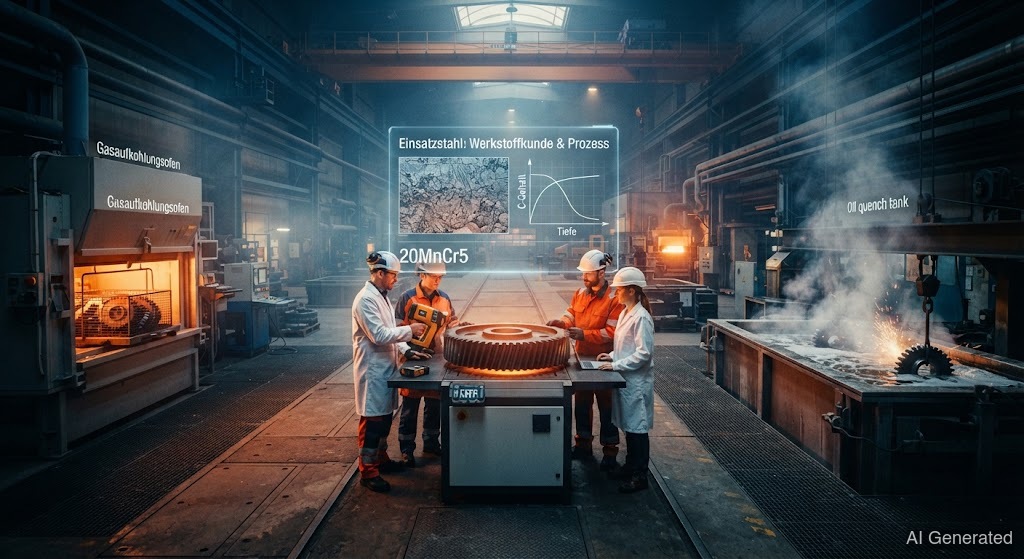 AI generated
Case-hardening steels have low carbon content and are only carburized and hardened after shaping. This gives a tough core with a surface – ideal for gears and shafts. When , the condition matters: soft is easy to weld, hardened is risky.
Case-hardening steels solve a classic problem: a gear should be hard and on the outside, but tough on the inside so it doesn't break under impact. The trick is called . The steel starts with low (0.1–0.25%) – soft and tough. After shaping, the surface is "carburized" in a furnace that releases : diffuses into the surface layer. Then it's – the carbon-rich edge becomes glass-hard, while the low-carbon core stays tough.
The typical representatives: , , and . The and manganese improve , and adds to . The result is measured by the – the depth to which the hard layer extends. The whole process is called , and the hardened surface is produced by .
For you as a welder, what matters is the condition of the steel. In the soft initial state (untreated), a welds almost as easily as structural steel – the low carbon content makes it easily weldable. It's a different story if the part is already case-hardened: the hard surface layer with its high carbon content forms brittle during and cracks. The weld also destroys the carburized layer irreversibly.
So the rule is: avoid welding case-hardened parts if possible. If you must, then only with , suitable filler, and knowing that the hardened layer is lost at the weld. After , the part must be re- and hardened if it's to get its back.