Solidification of the Weld Pool
How the liquid weld pool becomes a solid, directionally dependent weld bead
 AI generated
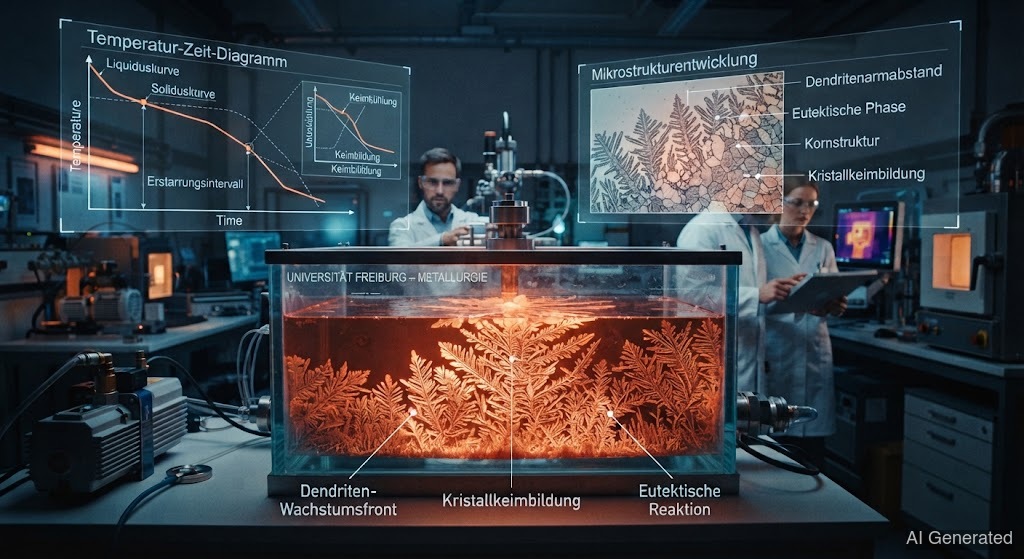
The weld pool is liquid metal that solidifies in fractions of a second. Crystals grow from the weld flank toward the center, form, and this is exactly where solidification and hot cracks originate. Whoever understands solidification knows why the weld center is the weak point — and how to avoid it.
In , the melts the base and into a liquid weld pool. What happens next determines the quality of the weld bead: The melt solidifies in fractions of a second, not just randomly, but according to fixed metallurgical rules.
Solidification always starts at the coldest spot — that's the weld flank, i.e., the contact with the still solid . Here, at the fusion line, the first nuclei form. Because heat flows outward, the crystals grow from both flanks perpendicular to the fusion line toward the center of the weld. Long, columnar crystals form — the . In the weld center, the two growth fronts meet.
Exactly this spot is the Achilles heel. When they meet, the growing crystals push the last impurities and low-melting constituents ahead of them — they collect in the center as . This centerline segregation is the classic zone for and , because harmful elements like sulfur and phosphorus are concentrated there, and the weld is under tensile stress during shrinkage.
A second problem is the — the temperature range between the start and end of solidification. Pure metals and eutectics solidify at a fixed temperature, alloys over a range. The wider this interval, the more likely a mushy transition state forms, in which cracks can occur. That's why some steels (with high sulfur/phosphorus content) are especially crack-sensitive.
You have two levers against . First, composition: A filler with some (in stainless steels) or clean, low-sulfur fillers keeps harmless. Second, geometry: A too deep, narrow weld pool (deep penetration ratio) forces the crystals to grow directly toward each other and press all impurities into the center. A wider pool or weaving distributes the solidification front and defuses the center.
Also, the in the subsequent depends on solidification: The weld pool releases so much heat that the next to it coarsens. Coarse grains are softer and more crack-sensitive — another reason to keep heat input under control.