Annealing & Normalizing
Soft annealing, , — the gentle heat treatments
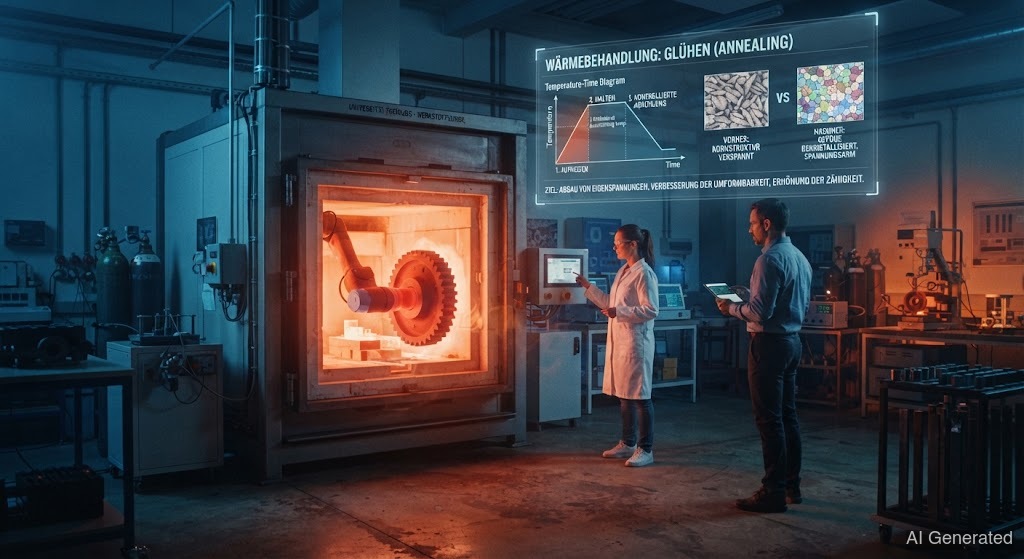 AI generated
Not every heat treatment makes harder. and make steel softer, more uniform, and less stressed — exactly what you often need after . is the most important post-treatment of all to reduce residual stresses and crack risk.
Besides , there are gentle heat treatments that make steel softer, finer-grained, or less stressed. For welders, they are often more important than — because they come after the weld bead.
is the umbrella term for heating + slow cooling. Depending on temperature and goal, several types are distinguished:
(650–720 °C) makes high-carbon and alloyed steels easy to machine. The clumps into round grains, and the structure becomes soft. You mainly need this for before you machine them.
(550–700 °C) makes cold-formed metal soft again. After heavy rolling or bending, the structure is strained and hardened (); forms new, stress-free grains.
(above 900 °C, then cool in still air) is the "restart" of the structure: the steel is fully austenitized and forms a fine, uniform grain on cooling. The result is a homogeneous, easily weldable condition — that's why parts are normalized after forging or casting.
(550–650 °C) is the most important post-treatment after . During , arise: the cooling weld bead wants to shrink but is held back by the cold . These tensile stresses, together with hydrogen, can lead to . In , you let the steel "creep" slowly at high temperature — the stresses relax without much change to the structure.
Why is this important for you? After thick, heavily restrained parts, these stresses are real and dangerous. reduces crack risk, improves dimensional stability, and — for certain steels — the . The catch: it takes hours, needs a furnace, and is often not possible for large parts. Then only good welding sequence and intermediate annealing help.
A word about temperature: all annealing treatments are below the transformation temperature (except ) — so they don't change the structure, only the stress and grain condition. That's exactly why they are so controllable.