Cast Iron Materials
Gray cast iron (GJL), ductile iron (GJS), and the challenges of repair welding
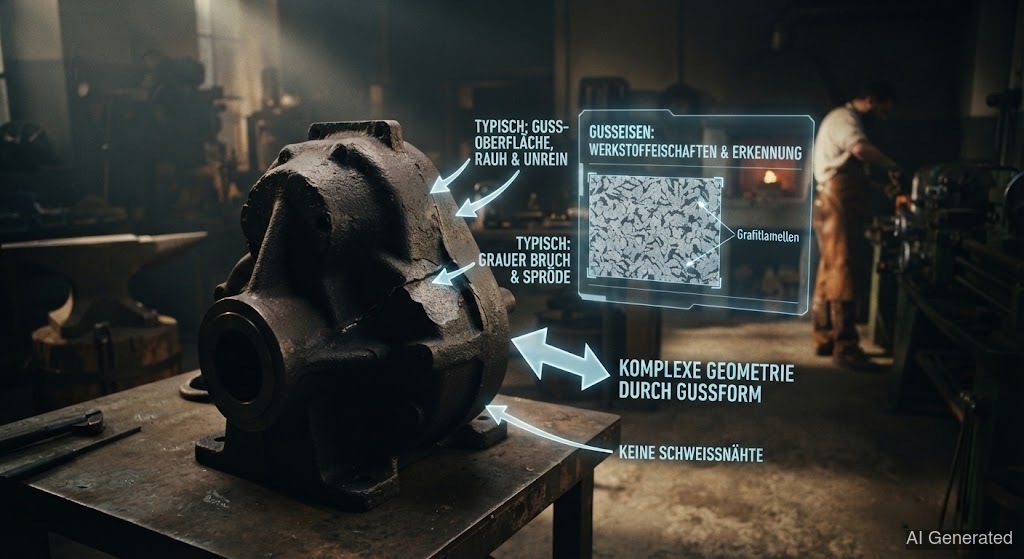 AI generated
Cast iron contains more than 2% , which is precipitated as graphite during solidification. The graphite form – flakes, nodules, or compact – determines the properties: gray cast iron is brittle but strong in compression and vibration-damping, while ductile iron is tough and deformable. Repair welding requires special care due to the tendency for hardening and cracking.
Cast iron is not a single material but a whole family – and the difference lies in the form of the . Unlike steel, the carbon content here is above 2%, and the excess precipitates as during solidification. Whether the graphite grows as flakes, nodules, or worms determines everything else.
In gray cast iron (GJL), the grows as fine veins. The flakes act like countless tiny notches – they make the material brittle and practically non-deformable. However, it is vibration-damping, easily castable, and excellent in compression. You'll find gray cast iron in machine beds, housings, brake discs, and old engines. In ductile iron (GJS), on the other hand, the graphite is forced into through the : Just before pouring, the melt gets some magnesium, which prevents the from growing as brittle flakes. Nodules are not notches – the material becomes tough, , and deformable, almost steel-like. Ductile iron carries crankshafts, steering knuckles, and pipelines. There is also compacted graphite iron (GJV) with worm-like as a compromise, and white, , where the is not present as graphite but as hard iron carbide.
Why is so tricky here? Two reasons. First: Where the melts the cast iron and the mass then cools quickly, exactly what the foundry wanted to avoid forms in the – hard, brittle and ledeburite. The becomes glass-hard and cracks at the slightest . Second: Cast iron is porous and often soaked with oil, grease, and rust – during , these impurities escape as gases and ruin the weld.
The repair strategy is therefore: control the heat. Either you weld "cold" with low heat and special electrodes that remain soft and , or you preheat the entire component to 300–600 °C, weld hot, and let it cool extremely slowly in an oven. In both cases: The and slow cooling are the be-all and end-all. Anyone who "quickly" welds an old gray cast iron crack with a regular mild steel electrode usually only makes the crack longer.
⚠️ The 20-degree trap: With cast iron, a difference of just about 20 °C between the cool spot and the zone you are currently welding is enough to trigger a . The warm area contracts as it cools and pulls on the cold remainder – and the brittle cast iron cannot relieve this stress. Therefore: keep the temperature gradient small, whether you weld cold or hot.
🧊 Cold welding needs patience: If you weld cast iron in the cold state, take your time. Lay only short stringer beads and let the component cool down to repeatedly in between before laying the next bead. If you rush and lay bead after bead, you drive the temperature up – and that's exactly when the 20-degree trap strikes.