Hardening & Tempering
Austenitizing, quenching, — the master discipline of heat treatment
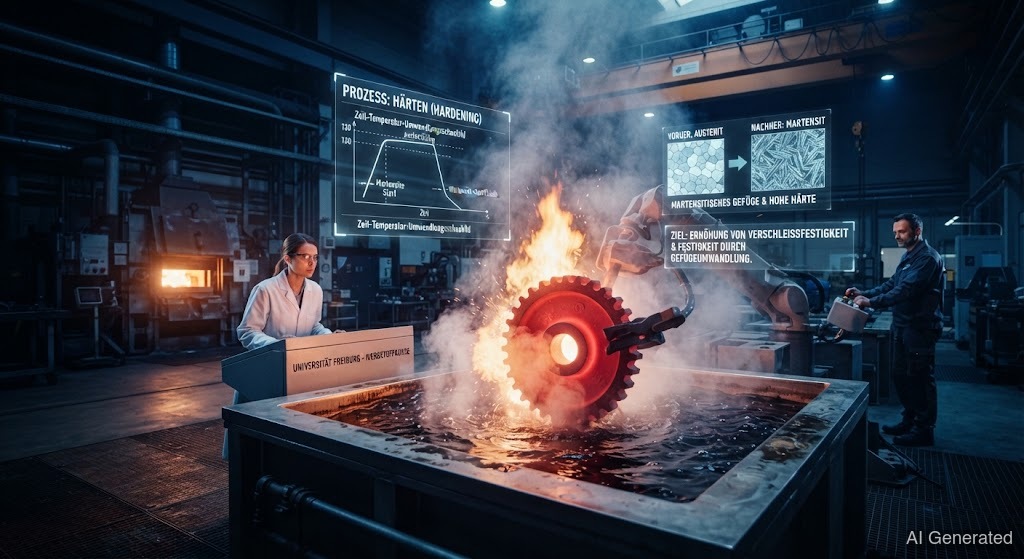 AI generated
makes steel glass-hard, but also brittle — so every is followed by . Together, this is called and produces the perfect combination of strength and . If you understand the process, you also know why the hardens during and how to prevent it.
is the most targeted intervention you can make to a steel. The process is always the same, and once you understand it, it also explains the hardening during .
Step 1: . You heat the steel above the transformation temperature (780–910 °C depending on carbon content) and hold it there until the entire structure has become . The now dissolves evenly in the lattice.
Step 2: . You cool so rapidly — in water, oil, or air — that the has no time to precipitate as . Instead, the lattice collapses forcibly and traps the : forms — glass-hard, but brittle and full of internal stresses.
Step 3: . Now comes the most important step that beginners often forget. You reheat the to 150–650 °C. This relieves the stressed lattice in a controlled way: the drops somewhat, but the increases massively. Only this hardened + tempered state is usable.
If you temper bare steel, you read the temperature from the color — the temper colors tell you where you are:
The hotter the clean piece gets, the thicker the oxide layer and the more the interference color shifts from yellow through blue to gray. Toolmakers read the tempering temperature from it—on clean bare metal, not scale.
The whole package — plus — is called . Quenched and tempered steels (like ) achieve exactly the combination of high strength and good that shafts, gears, and highly stressed components need. The result is a fine of tempered .
For you as a welder, this three-step process is doubly important:
1. The is an unintentional . The austenitizes the next to the weld, and the cold plate quenches it. In high-carbon steels, forms in the — the classic cause of .
2. destroys the quenched and tempered condition. In the , the tempering is either over-tempered or completely dissolved — the steel is softer there than the quenched and tempered base material. That's why quenched and tempered components are often re-quenched and tempered after .
The hardenability depends on the alloying elements: , , and manganese slow down the transformation, so that even slower cooling is enough for . The summarizes exactly this effect.