Types of Corrosion
Pitting, , intergranular, crevice and galvanic corrosion
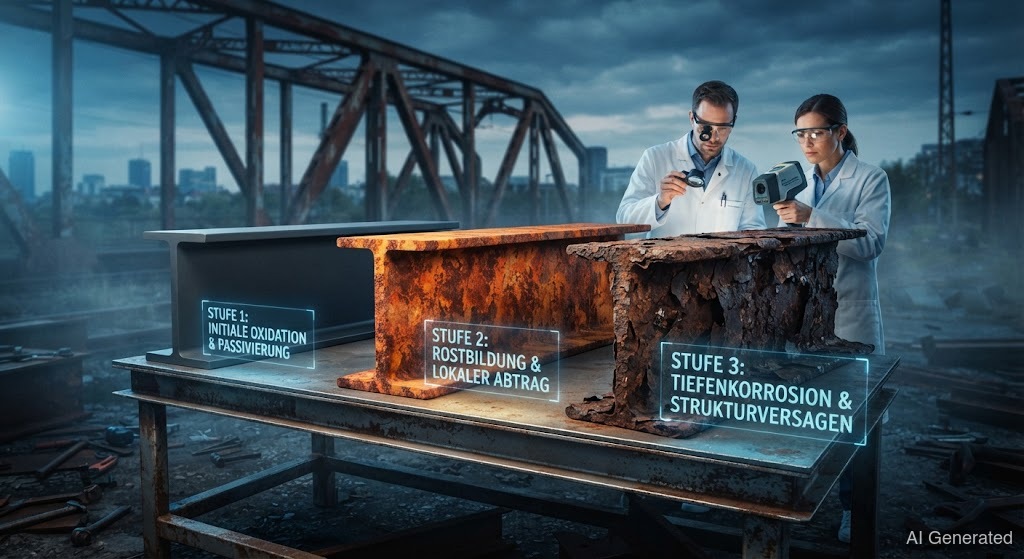 AI generated
is not just . There are at least five types, and each has its own causes and remedies: pitting eats locally, cracks under tension, intergranular destroys the grain boundaries. If you can tell them apart, you choose the right material — and the right filler.
When metal "rusts," one of several types of corrosion is almost always behind it — and each one needs a different remedy. You should be able to tell the five most important ones apart.
is the most insidious attack on stainless steels. At tiny spots, the protective breaks down, and it eats a hole into the depth — while the surface next to it stays bright. Triggers are almost always chlorides (saltwater, road salt, swimming pools). The content is decisive: The more , the more resistant. That's why 316 (with Mo) handles chlorides better than 304 (without Mo).
(SCC) hits austenitic stainless steels under tensile stress in a hot, chloride-containing environment. The tricky part: The material suddenly cracks, even though it looks barely corroded. The combination of tensile stress + chloride + temperature is enough. Residual stresses from are a classic trigger — which is why is doubly important here.
destroys the steel along the grain boundaries. The cause is : When chromium carbides form at the grain boundaries during , the protective is missing right there. This happens with "sensitized" stainless steels after heating to 500–800 °C. Remedies: low-carbon grades ("L") or stabilized grades with titanium/niobium.
occurs in tight crevices where the medium stagnates and oxygen is lacking — under gaskets, bolt heads, overlapping sheets, and poorly penetrated welds. The lack of oxygen prevents the from repairing itself. Remedies: avoid crevices, weld through cleanly, design sealing surfaces to be tight.
(contact corrosion) occurs when two metals of different nobility are electrically connected and an electrolyte (moisture) is added. The less noble metal sacrifices itself — classic: steel bolt in aluminum, or galvanized sheet next to stainless steel. Remedies: choose materials with similar potential or isolate them galvanically.
Then there's also surface wastage (uniform rusting of structural steel) and high-temperature . For the welder, the rule is: The type of corrosion determines the material AND the filler. The filler must have at least as high a content of and as the , otherwise the weld bead will rust first.