Crystal Lattice & Microstructure
Body-centered cubic, face-centered cubic, hexagonal — and why it matters
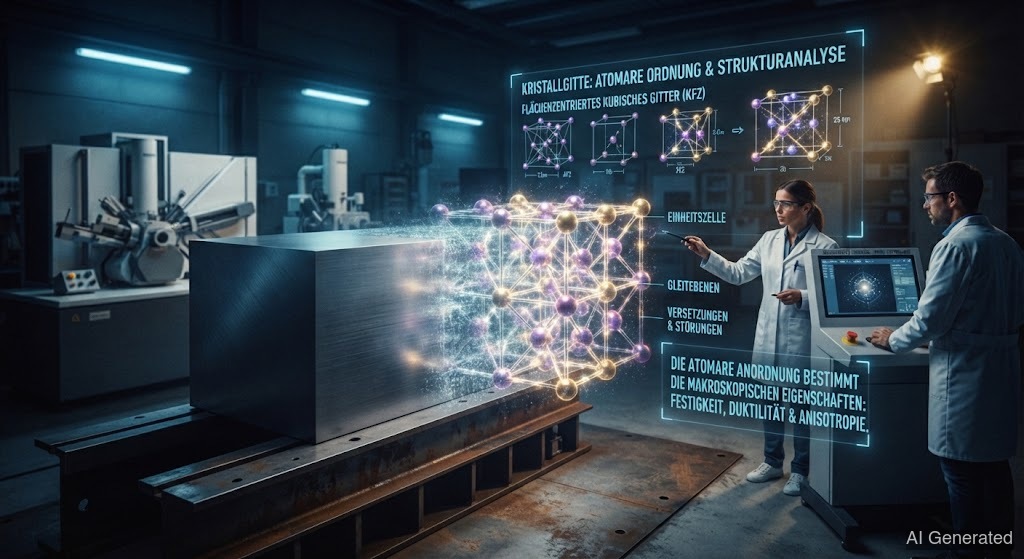 AI generated
Metals do not solidify chaotically but in regular crystal lattices. Iron changes its lattice when heated — and it is precisely this change that causes , , and . Knowing the lattice types helps you understand the most important transformations in steel metallurgy.
Metals are crystalline. That means their atoms are not randomly distributed but sit in a regular, repeating pattern — the crystal lattice. The smallest building block of this pattern is called the unit cell, and for metals there are mainly three types.
Body-centered cubic (bcc): One atom in each corner of the cube plus one in the center. This lattice is what iron has at room temperature — as . It is densely packed, but the slip possibilities for atoms are limited.
Face-centered cubic (fcc): Atoms in the corners plus one in the center of each face. In this lattice, iron exists between 911 °C and 1392 °C — as . The fcc lattice is "airier" and can be deformed much better; at the same time, significantly more atoms dissolve in its gaps.
Hexagonal close-packed (hcp): Found in zinc, magnesium, and titanium at room temperature. This lattice has only a few slip planes — which is why these metals are less formable when cold.
The crucial point for you as a welder: Iron changes its lattice when heated and cooled. At 911 °C, the bcc lattice flips into the fcc lattice — becomes . When cooling, the same happens in reverse. This lattice change is the cause of everything that happens during in terms of hardening:
• If the cools slowly, the carbon atoms have time to leave the fcc lattice — soft / forms.
• If it cools very quickly, the carbon atoms remain trapped and forcibly strain the lattice — hard forms.
A real piece of metal is not a single crystal, but consists of millions of tiny (grains) that meet at their boundaries. The grain size determines the properties: fine grain = stronger and tougher, coarse grain = softer and more brittle. During , the grain grows in the — which is why the coarse-grained zone next to the weld is the weak point.
Lattice defects are also part of everyday life. A missing atom (vacancy), an embedded foreign atom, or a dislocation (a built-in shift in the lattice) determine how the metal deforms and hardens. essentially means: you create so many dislocations that they block each other.