Alloying Elements & Their Effects
What , , manganese, & Co. really do in steel
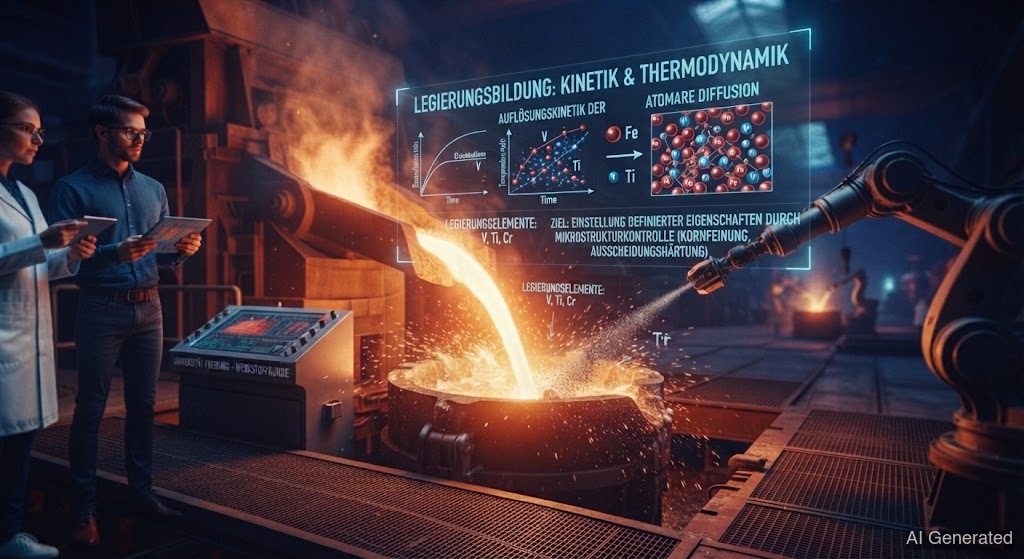 AI generated
Steel is iron plus targeted additions—and each alloying element has a clear job. makes it hardenable, makes it stainless, makes it tough, manganese binds sulfur, protects against pitting. If you know what the elements do, you can read any material designation like an open book.
Pure iron is soft and almost useless. Only the alloying elements turn it into the steel you know—each with its own job. If you know the most important ones, you can read from the material number how a steel behaves when .
(C) is the most important element of all. Even 0.1% changes everything: makes steel harder and hardenable, but lowers weldability. Every tenth of a percent above 0.2% noticeably increases the tendency in the . That's why the C content is the first thing you check on any data sheet.
(Mn) is the workhorse of steelmaking. It binds sulfur into manganese sulfide instead of brittle iron sulfide, deoxidizes the melt, and increases strength and hardenability. Almost every steel contains 0.5–1.5% manganese.
(Si) is mainly a deoxidizer—it captures oxygen from the melt. It also increases strength. That's exactly why it's in welding wires: it calms the weld pool.
(Cr) makes steel stainless. From about 10.5% , a dense, self-healing of chromium oxide forms on the surface—that's the whole secret of stainless steels. also increases hardenability and hot strength.
(Ni) is the toughness and austenite promoter. It stabilizes the structure even at room temperature (that's why stainless steels are non-magnetic), improves —especially at low temperatures—and lowers the transformation temperature.
(Mo) boosts hot strength (creep resistance) and—crucially—resistance to in chloride-containing media. That's why every 316 stainless steel contains , but 304 doesn't.
Then there are the specialists: , niobium, and titanium as refine the grain and bind /nitrogen into fine precipitates (hence fine-grain structural steels and stabilized stainless steels). for hot strength and high-speed steels. Sulfur and phosphorus, on the other hand, are unwanted companions—they embrittle and promote .
Remember the basic rule: and the hardenability-effective elements control weldability, // control and structure. The sums up the first group in a single number.