Case Hardening
, , induction hardening — hard shell, tough core
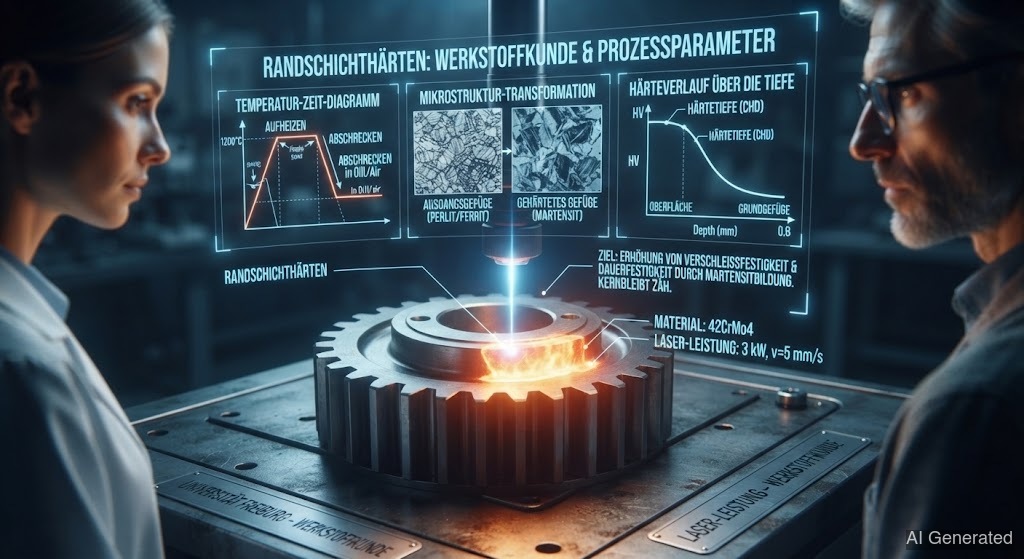 AI generated
Sometimes you only want the surface hard — the core should stay tough. That's exactly what case hardening processes do: , , and induction hardening. Gears, shafts, and bearings run hard on the surface and tough inside. Knowing them also helps you understand case-hardening steels.
A gear needs to be hard on the outside (to resist wear) but tough on the inside (so it doesn't break). Through-hardening would make it brittle all the way through. The solution is : only the outer layer is hardened, the core stays soft and tough.
( + ) is the classic process for low-carbon steels like . Here's how it works:
1. : The part sits for hours at 900–950 °C in a carbon-donating atmosphere. The diffuses into the surface layer until it reaches 0.7–1.0% C — the core keeps its 0.15%.
2. : Quenching turns the carburized surface into hard , while the low-carbon core stays soft.
The result is the perfect combination: hard surface, tough core. The (CD) tells you how deep the hard layer goes — typically 0.3 to 2 mm.
works with instead of . At 500–570 °C, nitrogen diffuses into the surface and forms extremely hard nitrides. The big advantage: no quenching, so almost no distortion. Nitrided layers are very hard and , but thin (0.1–0.8 mm).
heats only the surface zone in a flash with an induction field and quenches immediately. That's ideal for large parts like crankshafts and racks: selective, fast, and with a defined hardening depth.
All three processes are directly related to :
• Case-hardening steels are easy to weld before (soft, low carbon). After , the surface is too hard and crack-prone to — weld beads belong in the soft core state, before .
• Nitrided surfaces can't be welded anymore without destroying the hard layer.
• If you weld a carburized or nitrided part, you destroy exactly the hard surface layer in the that the part needs.