Filler Metals & Their Selection
Why which filler — the five rules no data sheet tells you
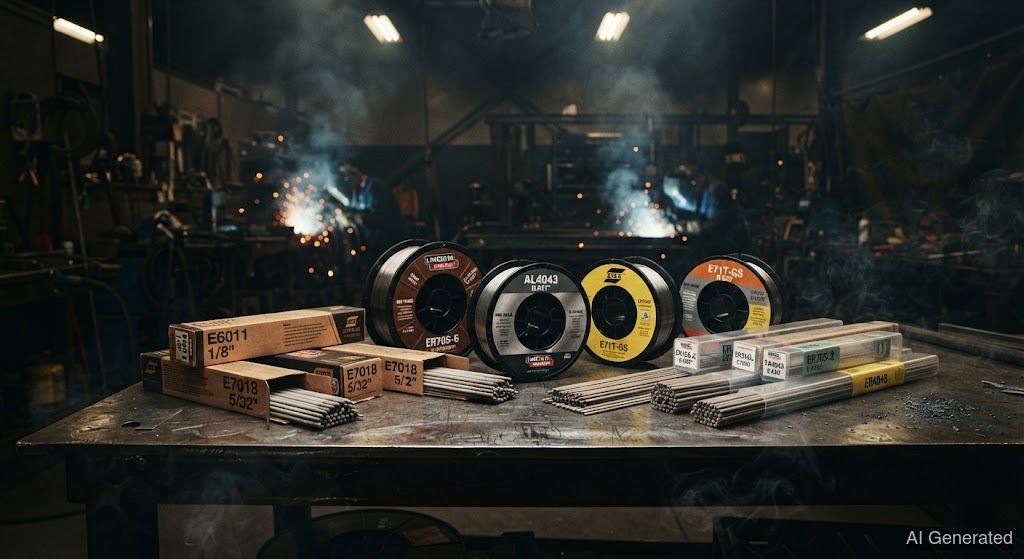 AI generated
The filler metal decides whether your weld bead holds or cracks — and yet the selection is hardly explained anywhere properly. The must match the strength, the alloy, and the service condition of the . Here you'll learn the five rules to always pick the right wire, rod, or electrode.
The is the component you weld. The is the material you add — wire, rod, or electrode. Together, when melted, they form the , i.e., the metal that your weld bead actually consists of in the end. That's the point: Your weld bead is neither pure nor pure filler, but a mixture of both.
That's why it's not enough to grab "some stainless wire." You choose the filler so that this mixture ends up with the properties the component needs. There are five rules for that.
Rule 1: The strength must be right. The filler must at least reach the (Rm) of the , and usually also the . For a , you don't use a filler for . The exception is deliberate "undermatching": For crack-sensitive, high-carbon steels, you deliberately use a softer filler because it relieves stresses better — but only if the design allows it.
Rule 2: The alloy must keep up. The filler must be at least as highly alloyed as the , otherwise the weld bead loses its special properties. If you weld a steel with an unalloyed wire, the weld bead itself will rust. Rule of thumb: Stainless steel → stainless filler, and for dissimilar joints (steel to stainless), choose the higher-alloyed filler.
Rule 3: Predict the microstructure. For stainless steels, the composition determines whether or forms in the weld bead — and a few percent prevent . You calculate this using the : You form a (from Cr, Mo, Si, Nb) and a (from Ni, C, Mn) and read off the diagram which microstructure forms. This is exactly what the filler calculator in the Studio does automatically.
Rule 4: Account for . The melts not only the filler but also part of the . This portion dilutes the weld bead — that's the . For the root pass, this can be up to 40%. If you don't account for this, your microstructure prediction from Rule 3 won't hold.
Rule 5: The service condition decides. The same needs a different filler depending on the application: For cold conditions, a , tough filler with good ; for heat, a creep-resistant one; for , one that's appropriately alloyed.
Plus, there are the four basic types of filler. The for / is a solid cross-section wire. The has a powder filling that forms slag and provides . The for SMAW (stick) brings its — for toughness, for ease, for penetrating the root. And the is fed separately; the process doesn't need a coating.
The standard designation tells you the rest. A solid wire per DIN EN ISO 14341-A is called, for example, "G 42 4 M21 3Si1" — G for solid wire, 42 for the (at least 420 MPa), M21 for the (argon + CO₂), 3Si1 for the alloy. Electrodes per DIN EN ISO 2560 carry designations like "E 42 5 B 4 2 H5". If you can read these codes, you can see at a glance whether the filler fits — strength, , coating type, and hydrogen limit.