Hot-Work Tool Steels
Hot-hard at red heat — for die casting, forging dies, and injection molding
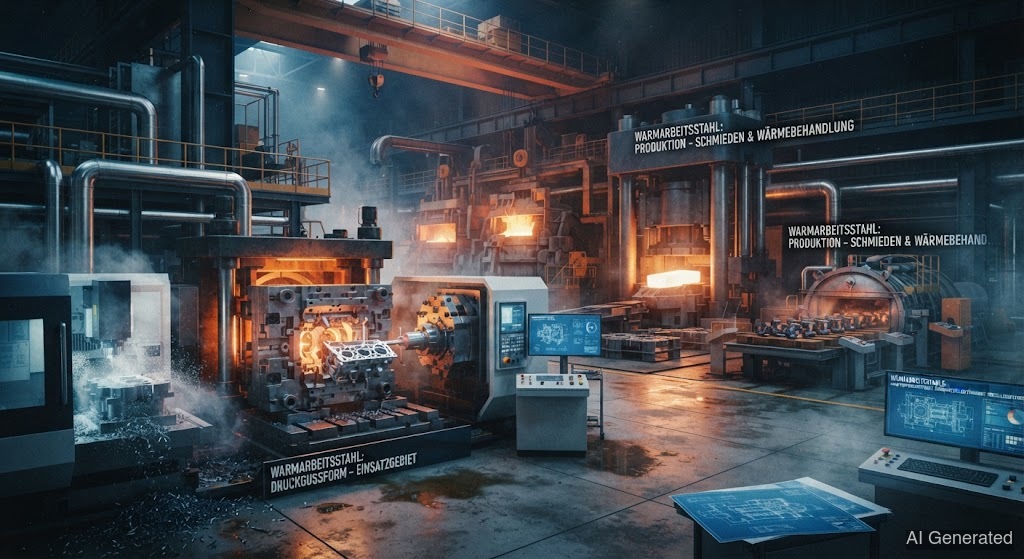 AI generated
Hot work tool steels like 1.2343 and 1.2344 withstand temperatures of 500 °C and more without losing their strength — the trick is a CrMoV alloy with high hot hardness. When welding: use a matching CrMoV filler, exact preheating to 300–350 °C. And watch out: The same steel lives in three worlds with three different fillers.
Hot work tool steel is the tool steel for hot forming: die casting, forging dies, extrusion, hot forming. While cold work tool steel cuts at room temperature, hot work tool steel works where the workpiece glows — 300 °C to over 600 °C hits the tool surface, thousands of times in a row. A normal tool steel would temper at this heat, lose its hardness, and the mold would be ruined after a few shots. Not hot work tool steel — that's exactly what it's made for.
The secret: chromium, molybdenum, and vanadium
The alloy is tuned for hot hardness. Chromium (around 5 %) and molybdenum (1–3 %) together with vanadium form finely distributed carbides that hold the structure together even at red heat. The steel stays strong and dimensionally stable while it forms glowing metal and gets several hundred degrees hot itself.
The most important grades:
• 1.2343 (X37CrMoV5-1) — the all-rounder and top material. The classic for die casting molds, forging dies, and extrusion tools.
• 1.2344 (X40CrMoV5-1) — the big brother with more vanadium: even tougher and more hot-hard, for the harder hits.
• 1.2367 (X38CrMoV5-3) — the specialist with the highest molybdenum content: maximum hot hardness and best thermal shock resistance.
• 1.2365 (32CrMoV12-28) — more carbon, for hot work tools that really get hot.
• 1.2714 (55NiCrMoV7) — the tougher one for forging dies: nickel makes it break-proof under impact.
One steel, three worlds — three fillers
Now here's the point many overlook: The same 1.2343 lives in three separate application worlds, and each demands a DIFFERENT welding filler. If you use one filler across all three worlds, you end up welding wrong.
• Die casting and forging die → hot-hard CrMoV filler. Here hot hardness counts: The filler must bring the same hot hardness as the base material, otherwise the repaired spot fails on the next hot shot. Weld with matching material, don't improvise.
• Injection molding → wear-resistant/corrosion-resistant, NOT hot-hard. In the injection mold, thermal shock is much milder — plastic comes at 200–300 °C. Instead, abrasion and corrosion matter. A hot-hard filler would be the wrong friend here; wear-resistant and corrosion-resistant is what's needed.
The core: The application decides the filler, not the material alone. This application blindness is the most common mistake with hot work tool steel.
When welding, the whole tool steel discipline applies:
• Preheat to 300–350 °C — measured with a thermometer, not guessed. Hot work tool steel is hardened and tempered; welding cold immediately creates glass-hard martensite in the heat-affected zone, which cracks on the next temperature change.
• Hot-hard CrMoV filler — matching the alloy, so the repaired spot keeps the same hot hardness.
• Keep interpass temperature — don't let it cool down between passes, otherwise the HAZ hardens up.
• Temper after welding — neutralize the fresh martensite before the tool goes back into hot service.
The classic damage: heat checking
Die casting dies don't die from one big crack, but from a thousand small ones: heat checks. The constant change between glowing metal and coolant tears the surface open like dried mud — a fine network of hairline cracks. These heat checks are the classic repair job: grind out, preheat, hot-hard filler, temper.
⚠️ Safety-critical: Die casting and forging tools are under extreme mechanical and thermal loads. After a repair, crack testing is mandatory. For safety-relevant applications, follow the standards and involve the responsible supervisory authority.