Tool Steels – Overview
Nine worlds, one basic principle: hard, – and demanding when
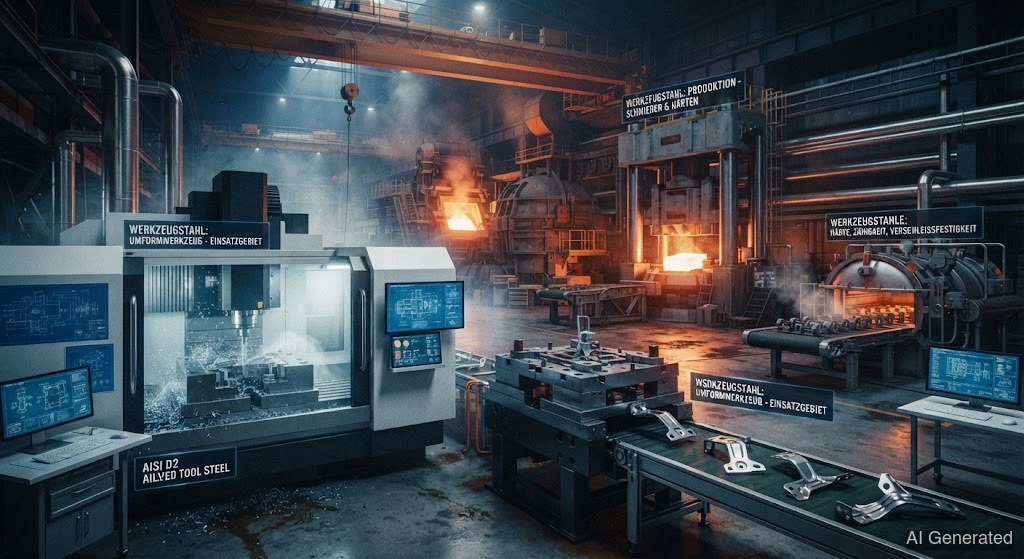 AI generated
shape other materials. But behind this umbrella term are eight separate worlds – from the cold cutting edge to the glowing die-casting die. Each has its own requirements and its own rules when .
are the materials with which other materials are shaped. They all share a high carbon content and plenty of alloying elements, because they need to be hard, and – depending on the application – hot-hard. Exactly these properties make them the most demanding materials of all when .
But "" is not a single material, but nine separate worlds that you have to keep clearly apart:
• – cutting, stamping, forming at room temperature. Maximum , maximum crack sensitivity when .
• – hot-hard at red heat. For , forging dies and extrusion; the same steel in three worlds with three different alloying concepts.
• – liquid metal under pressure, the most brutal thermal shock. Hot hardness is everything.
• – plastic molds, mirror-polished and dimensionally accurate. The surface matters.
• – drills, end mills, threading tools. even at red heat.
• – abrasive due to fillers, due to release agents.
• – dimensional stability at over 1000 °C.
• – pure when pressing and extruding.
• – abrasive and at the same time.
What connects them all is the common core: when , they harden glass-hard in the , and that is exactly where lurks. Therefore the same iron rule applies to all: never weld cold – preheat, weld hot, and cool down in a controlled way. The details then differ depending on the world.
Dive into the individual worlds to see the suitable materials, and in detail.