Non-Destructive Testing (NDT)
Ultrasonic, radiographic, magnetic particle, dye penetrant — find defects without destroying
 AI generated
Non-destructive testing finds cracks, pores, and lack of fusion in the weld without destroying it. Ultrasonic and radiographic testing look inside, magnetic particle and dye penetrant find surface cracks. Knowing the four methods tells you how a weld is really inspected.
Non-destructive testing (NDT) finds defects in the weld without damaging it. Four methods cover almost all cases — each with its own strength.
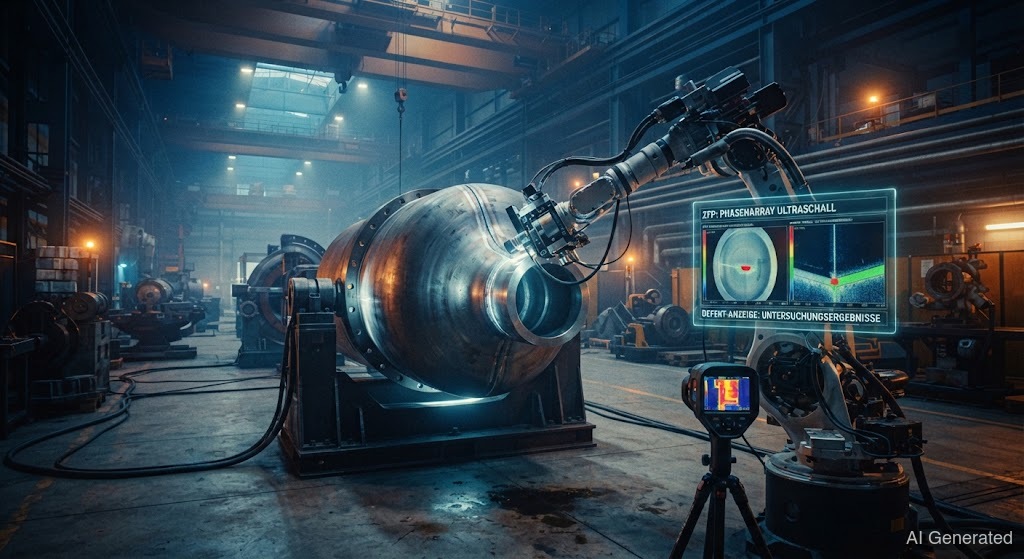
(UT) sends sound waves into the component. At every boundary — back wall, but also crack or pore — the sound is reflected. From the time of flight and the echo, the device reads the defect depth. UT is the workhorse for thick plates and welds: deep penetration, portable, immediate results. The downside: It takes experience to interpret the indications, and you need a smooth coupling surface.
Radiographic testing (RT, X-ray/gamma radiation) makes the weld visible like in an X-ray image. Pores, slag, and lack of fusion appear as dark spots on the film. The big advantage: The result is an image that can be documented and later reviewed. The downside: Radiation protection required, expensive, and planar defects (e.g., lack of fusion perpendicular to the radiation direction) are hard to detect.
(MT) finds surface cracks in magnetizable materials (all ferritic steels). The component is magnetized; at cracks, the field leaks out and attracts sprinkled iron powder. Cracks become visible as fine powder lines — extremely sensitive to surface defects. MT does not work for austenitic stainless steels and aluminum because they are non-magnetic.
(PT, ) is the simplest method and works on any material. A colored, capillary-active liquid penetrant is applied, seeps into cracks, the excess is removed, and a developer draws the penetrant out of the crack — the crack becomes visible. Ideal for surface cracks on stainless steel, aluminum, and anywhere MT doesn't work.
How to choose? Rule of thumb:
• Surface cracks: MT (magnetic) or PT (non-magnetic).
• Internal defects (pores, lack of fusion): UT (thick, economical) or RT (documentable, thin).
• Safety-critical welds: usually UT or RT, supplemented by MT/PT for the surface.
Important for you as a welder: NDT is no substitute for clean work — it reveals defects you'd rather not make in the first place. And every method has limitations: A lack of fusion that lies flat in the radiation direction can escape radiography. That's why methods are combined.