Cold Work Tool Steels
Cutting, punching, forming at room temperature
 AI generated
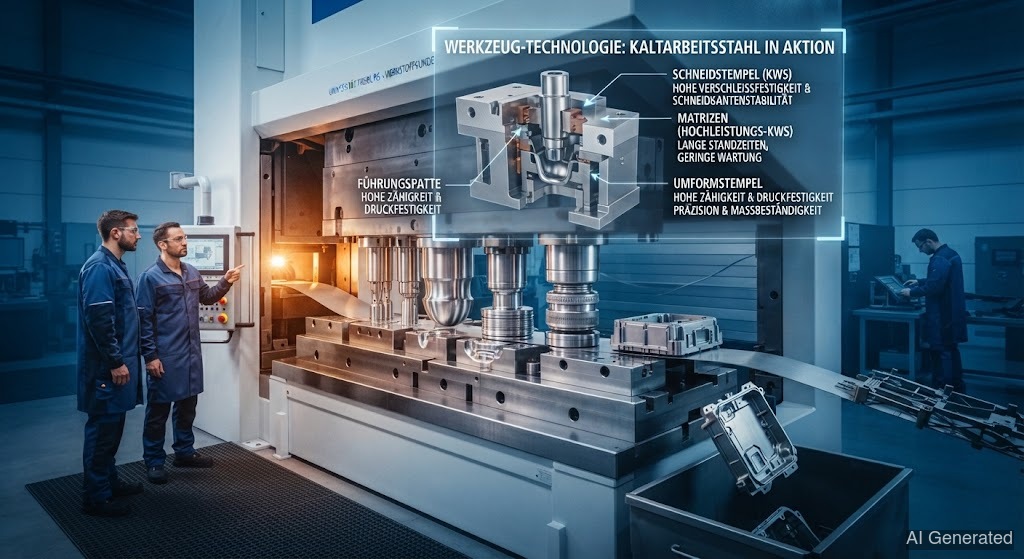
Cold work steels operate at room temperature and must primarily be hard and . They form sheets, cut threads, and punch contours. When , they are extremely crack-prone due to their high carbon content – , a backing, and peening are mandatory.
is the for cold forming: cutting, punching, stamping, forming, drawing – all at room temperature. The workpiece is cold, so the cutting edge doesn't need to be heat-resistant. Instead, it needs to be extremely hard and , because it cuts through sheet metal and bar stock like butter.
It's precisely this high carbon content that makes a problem when . The more , the harder the steel can be hardened – but the more brittle and crack-prone it becomes in the . When , the HAZ is practically hardened "in passing" and quenched instantly by the cold mass of the tool – leaving behind glass-hard that cracks at the slightest .
The most important representatives: (X153CrMoV12, the all-rounder with 12% for cutting and punching tools), (X210Cr12, the wear classic), (the tougher one for cutting inserts), and (the economical choice for simple cutting edges). There's also (60WCrV7) for impact tools that need more than .
When , the whole discipline applies: never weld cold, (200–300 °C depending on carbon content), use a matching filler metal, and the weld. With , a also helps: it insulates against heat loss and keeps the HAZ warm longer before it cools.
The classic mistake: someone "quickly" welds a crack in a punching tool with a standard structural steel electrode. The weld looks fine – but the HAZ next to it is glass-hard and cracks on the next stroke. So: repair only with a systematic approach, or honestly consider replacing it.