Powder Metallurgy Steels (PM)
Built from powder instead of melted: uniform structure, no , more
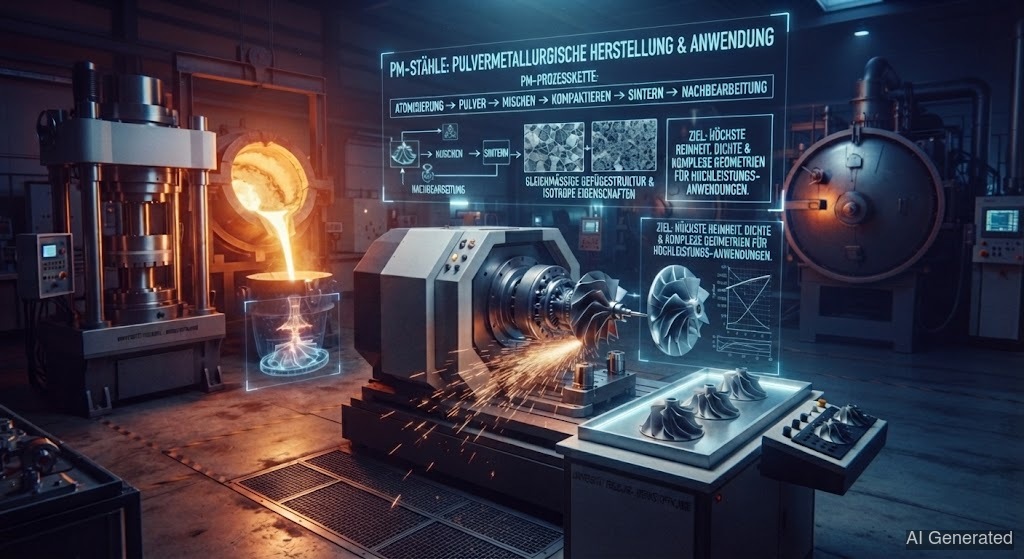 AI generated
Powder metallurgical steels aren't melted in liquid form but consolidated from metal powder and hot-compacted. This creates a fine, uniform structure with finely distributed carbides – at the same , they're often tougher than conventionally melted steels. When , however, they behave like high-alloy .
With a regular steel, you pour the melt into a mold and let it solidify slowly. That's exactly where a problem arises that powder metallurgy avoids: . During slow solidification, the alloying elements – especially and the carbide formers – migrate and accumulate unevenly. Coarse carbide clusters form, and properties vary from spot to spot.
(PM) takes the opposite route. The steel isn't cast as an ingot but atomized into fine powder – each powder particle solidifies almost instantly. The powder is then filled into a mold and consolidated under high pressure and heat, usually by or . Because each particle solidified in a flash, the melt has no time to segregate. The result is a structure that looks the same everywhere: fine, evenly distributed carbides instead of coarse clusters.
And that's exactly the point of PM steels: at the same , they're tougher and more consistent in behavior. A conventionally melted steel with lots of or forms coarse carbides that act like predetermined breaking points. PM steel distributes the same carbides finely in the structure – stays, but noticeably increases. That's why PM steels are used wherever a tool needs to be both hard and impact-resistant: in stamping and shearing tools, milling cutters, drills, plastic molds, and good knives.
You distinguish two main families. Powder metallurgical high-speed steels – such as and – keep their cutting edge even at red heat and use during . Powder metallurgical – such as CPM 3V or Vanadis 30 – combine high with exceptional for impact and shear loads. Both families are closely related to classic , but made via powder metallurgy.
When it comes to , you have to be honest: PM steels are among the toughest welding cases at all. The reason lies in the . There, the structure doesn't melt, but it gets so hot that the finely distributed carbides coarsen and regroup – exactly the advantage you bought the PM steel for, the fine grain, is lost there. Plus, the sintered or HIP-consolidated structure reacts sensitively to the rapid heating and cooling of . The result is high crack risk and a HAZ that's noticeably softer or more brittle than the . Repair welding on PM tools is therefore always a risk – often replacing the part is the more honest solution.